• Is Nepal Ready for the Growth of Tourism?
    May 24, 2013
    Is Nepal Ready for the Growth of Tourism?

     Laura Chapman —

    Known for its mountain expeditions, rafting, and trekking, Nepal is quickly growing into one of the hottest adventure tourist destinations around the world. Mount Everest is without a doubt Nepal’s greatest claim to fame. As more tourists infiltrate the country to fulfill their dream of climbing the world’s highest peak, the added media attention contributes to an increased awareness and interest in tourism to the country. But recent events have raised concern about the ability of the country to handle the future influx of tourists.

    Tourism is an important industry for the stagnant Nepal economy as nearly twenty-five percent of the country remains in poverty. For some residents, tourism is the primary source of income while for the majority of people, subsistence farming is the main source of livelihood. The Nepalese tourism industry was pioneered in the mid-20th century and much of the credit belongs to Tenzing Norgay, a Sherpa who met Sir Edmund Hillary of New Zealand. Together, the duo successfully made the first ascent and return from the summit of Mount Everest in 1953. Since then, thousands of foreigners have followed in Sir Edmund’s footsteps and what was once an unbelievable feat of humankind is now an annual tourist experience and source of income for a growing community of Sherpa guides.

    Mount Everest: More Tourists But Not Less Risk

    You typically wouldn’t expect to see a crowd at the summit of Mount Everest but that is now a common sight as more foreign tourists journey to Nepal to ascend the mountain each year. Last year alone, more than 500 climbers made it to the summit. On rare occasions, more than 100 people have been known to be at the summit on the same day. For experienced climbers, the experience is no longer the same as the groups of climbers have led to the domestication of the standard route. The unforgiving remoteness and extreme altitude of Mount Everest is no longer seen as a risk to even amateur climbers although one must pay a significant fee for a professional guide. More than fifty years since the first climb, the risks have not changed but that isn’t stopping people from coming.

    Inexperienced climbers now clog the route during the few days that weather conditions are best. The mass group of climbers is usually clipped onto a single fixed rope anchored to the mountain which they must not deviate from. But the risks are very much alive with ten deaths last year alone. Amateur climbers often presume that hiring a guide can make up for their own lack of experience but that misconception puts themselves in danger of failing to recognize their own limits. There is no shortage of problems that could arise.

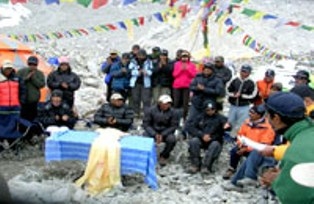
    Last month, three Western climbers were confronted by a mob of angry Sherpas at their campsite. Rocks were thrown and blood was shed in a battle that lasted nearly 50 minutes. While the situation has never been known to happen before and nobody was seriously injured, the incident was incredibly dangerous as death is always a risk.The incident raised major concern about the relationship between Sherpas and western climbers as well as the safety of all parties should a future incident occur.

    According to Kenton Cool, an experienced British mountaineer, Sherpas are brave and hardworking. He says they are also very hospitable people in spite of the rudeness that foreigners often exhibit towards them. Sometimes foreigners can be dismissive and while much of it is merely unintentional cultural offences, some are blatantly rude.

    Growth of Tourism Requires Growth of Services and Support

    There is no shortage of theories on what caused this dispute but now industry stakeholders are calling on the government to take greater measures and build infrastructure to manage a variety of potential problems. With the further commercialization of the mountains, there is growing need for security, safety, and medical facilities at base camps but the government has been slow to respond. As tourism builds, the need will only grow greater as the mass influx creates the risk of future issues.

    Furthermore, safety and security are two fundamental ingredients in creating an environment that is welcoming for tourists. The industry is calling on the government to arrange for emergency medical support, special medical camps, and the establishment of tourist police. Without such support and more stringent safety rules, climbers will face even greater hazards on the mountain than altitude and weather as the mountain becomes more crowded from the increased number of climbers. Experienced climbers often say, “The most dangerous thing about Everest is everyone else who’s trying to climb it.”

    Domestic Tourism Faces Challenges

    All of the attention on Mount Everest isn’t just fueling foreign tourists. Domestic tourism is also on the rise and with it comes its own separate set of challenges. According to local tourism operators, Nepal’s younger generation is travelling more as they discover that adventure tourism is not restricted to foreigners or as expensive as they think.

    The World Travel and Tourism Council reported that domestic tourism spending represented just over 65% of the total sector. This resulted in job growth in the region. But one major issue undermining growth in the region is the preference toward high-yield foreign tourists among Nepali vendors. According to economist Mukesh Khanal, if the discriminatory attitude towards domestic tourists does not disappear, locals will go elsewhere for their tourism adventures in places like Thailand or Malaysia where they are welcomed as guests.

    Slowly attitudes are changing and domestic tourists are earning the respect they deserve as local tourism operators recognize their importance to business. For the Nepal government, what should have been a celebration of the 60th anniversary of the first men to reach the summit of Mount Everest is now a harsh reminder of the demands of tourism. If the country wants to enjoy the economic benefits of the rise in tourism, it is inevitable that the government will need to start practicing destination management.

    With the eyes of the world on Nepal more than ever before, bad press is the last thing the impoverished country needs. Mass tourism may just be a way to rise out of the ranks of poverty and stimulate other industries that benefit from tourism. For the sherpas, they would be hard pressed to find an income that is equivalent to what they earn from western climbers. It’s a relationship that should be managed as more foreigners enter the country. The sherpas and foreigners are interdependent. While sherpas earn an income, climbers reach their goals on the backs of people working hard for them carrying their equipment. It would be hard to claim that you could climb Mount Everest alone.

    It would be hard to claim that you could climb Mount Everest alone. Ultimately, the future of tourism needs to take its inspiration from the original duo that pioneered tourism to the region. Sir Edmund Hillary and Sherpa, Tenzing Norgay made a pact never to disclose who made it to the top of the mountain first. They insisted that it was a team effort which is no doubt a true example of what the climbing community represents and indeed what tourism stakeholders and government must learn as well.

    Laura Chapman is a freelance writer based in UK. Laura , involved in research of various issues of mountaineering , has contributed this feature to Travelbiznews.com
    • Connecting you with the world of travel and tourism

      Asia Amusement & Attractions Expo 2026

      Theme Park Expo Vietnam 2025

      Asia Pool & Spa Expo , May 10 – 12, 2025 , Guangzhou , China

      KAZAKHSTAN International Exhibition “Tourism & Travel” Almaty, Kazakhstan

      Nihao China- Beyond your imagination

      Zhejiang Province , China

      Bangkok named Asia’s best

      holiday destination for 2025

      Bangkok has been ranked as the best city to visit in Asia for 2025 by Smart Travel Asia, a leading digital travel magazine, based on the opinions of hundreds of thousands of travellers and readers worldwide.

      The city received the highest votes in the “Best Holiday Destination in Asia” category, retaining its top position for the second consecutive year.

      Smart Travel Asia highlighted Bangkok’s strengths as its 24-hour vibrancy and diverse experiences, including food, culture, shopping, and the friendliness of its people, describing it as a “city full of energy and colour, day and night.”

      The city’s dominance stems from several compelling factors. Bangkok has emerged as a paradise for food enthusiasts, offering everything from legendary street food stalls to Michelin-starred restaurants and panoramic 360-degree rooftop bars. Its cultural and heritage sites, including the iconic Wat Phra Kaew, Wat Arun, and Wat Pho temples, remain major attractions to international tourists.

      Additionally, from luxury malls in the city centre to the Chatuchak weekend market, Bangkok caters to every type of shopper. Affordability and friendliness also play a key role, as Bangkok remains an accessible living cost destination where welcoming smiles continue to charm travellers.

      In the Smart Travel Asia 2025 rankings, Bali (Indonesia) and Tokyo (Japan) shared second place behind Bangkok, while Seoul (the Republic of Korea) and Luang Prabang (Laos) tied for fourth. Thailand further strengthened its tourism appeal with Chiang Mai placing third and Phuket sharing fifth place with Hong Kong (China).

      Having the three cities, Bangkok, Chiang Mai, and Phuket, in the top 10 highlights the diversity and appeal of Thailand’s tourism offerings for travellers worldwide. — VNA/VNS ( Oct.12, 2025)

      India resumes tourist visa for

      Chinese citizens after 5 years

      India announced  that it will open tourist visa applications to Chinese citizens from July 24, 2025. It was the first time in five years since the South Asian country suspended Chinese citizens’ tourist visa applications in February 2020.

      The Embassy of India in China announced via its Sina Weibo account  that, starting from July 24, 2025, Chinese citizens can apply for a tourist visa to visit India after completing an online application, scheduling an appointment, and personally submitting their passport and other required documents to three Indian visa application centers in Beijing, Shanghai, and Guangzhou in South China’s Guangdong Province.

      Responding to the related inquiry, Chinese Foreign Ministry spokesperson Guo Jiakun said  that “we take note of this positive move. Easing cross-border travel is widely beneficial. China will maintain communication and consultation with India to further facilitate travel between the two countries.”

      Chinese experts said the latest move taken by the India marks a phased milestone in the easing of relations between the two countries, and creates favorable conditions for further strengthening bilateral people-to-people exchanges.

      On February 2, 2020, India temporarily suspended its e-visa facility for Chinese travelers and foreigners residing in China amid coronavirus outbreak. – Global Times

      Gulf Cooperation Council Tourism 

      Dubai – As tourism destinations in the Gulf Cooperation Council (GCC) continue to grow, involving local communities in destination development has become increasingly vital for long-term success.

      Abu Dhabi’s Tourism Strategy 2030 aims for 39.3 million visitors per year, while Saudi Arabia’s Vision 2030 targets 150 million domestic and international visits, emphasising how tourism is being established as a key element of economic diversification throughout the region.

      At Arabian Travel Market (ATM) 2025, industry leaders emphasised that sustainable revitalisation of destinations must align tourism investments with community partnerships, cultural authenticity, and immersive guest experiences to provide lasting value for both residents and visitors.

      During the session on “Considerations and Implications of Involving Communities in Destination Revitalisation” on the ATM 2025 Global Stage, experts shared insights into building resilience, enhancing local prosperity, and ensuring tourism growth is both inclusive and enduring.

      Arabian Travel Market 2025, held under the theme “Global Travel: Developing Tomorrow’s Tourism Through Enhanced Connectivity”,  featured more than 200 speakers across three content stages and welcomes over 55,000 travel professionals from 166 countries.

      Messe Berlin India launched 

      to drive growth of ITB India 

      Messe Berlin announces the official launch of Messe Berlin India, a newly incorporated subsidiary that underscores the company’s long-term commitment to one of Asia’s fastest-growing markets. Headquartered in Delhi , the new entity will serve as a strategic base for expanding ITB India and launching future projects tailored to the Indian market. With this establishment, Messe Berlin is reinforcing its vision of India as a regional hub for innovation, collaboration, and sustainable business growth within the exhibition and events industry.

      “Messe Berlin’s presence in India reflects our strategic intent to strengthen our international reach by being where the growth is. India is a key market for us — vibrant, diverse, and full of opportunities. With Messe Berlin India, we are laying down long-term foundations to build strong partnerships, support local industries, and elevate our global platforms,” said Dr. Mario Tobias, CEO, Messe Berlin.

      ITB India, inaugurated in 2023, continues as the flagship event under the new subsidiary. Held annually, ITB India is a three-day B2B travel trade show and convention that connects the global travel and tourism industry with the Indian market. Alongside MICE Show India, Travel Tech India, and the ITB India Conference, ITB India serves as a unique platform to forge new partnerships, strengthen existing ties, and capitalize on the fast-growing potential of the Indian and South Asian travel economies. The show hosts key players from the MICE, Leisure, Corporate Travel, and Travel Technology sectors. The upcoming edition, ITB India 2025, will take place from 2 – 4 September 2025  in Mumbai.

      FACTS —

      Tourism helps in:

      👉Reducing poverty

      👉Reducing Inequalities

      👉Promoting gender equality

      👉Fostering decent work and economic growth

      World Tourism Day 2021: ‘Tourism for Inclusive Growth’

      In 2019, Travel & Tourism’s direct, indirect and induced impact accounted for:
      -US$8.9 trillion contribution to the world’s GDP
      -10.3% of global GDP
      -330 million jobs, 1 in 10 jobs around the world
      -US$1.7 trillion visitor exports (6.8% of total exports,
      28.3% of global services exports)
      -US$948 billion capital investment (4.3% of total
      investment)

      Tibet Travel : Daily Life of Living under Mount Everest