Nepal Info
Area: 147,181 sq. km
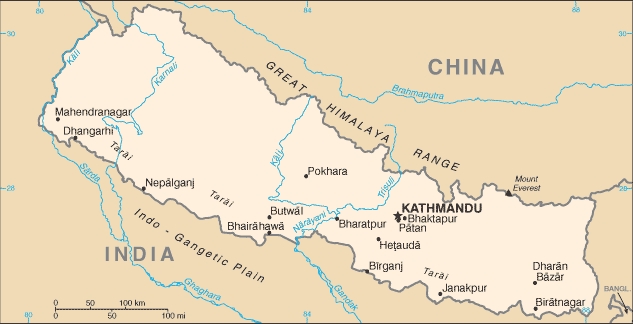
Location: Situated between China and India
Capital: Kathmandu
Population: 26.7 million
People: More than 102 ethnic groups and 92 spoken languages
Language: Nepali is the national language.
Religion: A secular state with predominance of Hindu and Buddhists
Currency: Nepali Rupee (approximately US$ 96 Rs)
Political System: Federal Democratic Republic
Climate: Four major seasons (1) Winter: December-February, (2) Spring:March-May, (3) Summer: June-August,(4) Autumn: September-November.Monsoons are from June till mid September.
Nepal is one of the richest countries in the world in terms of bio-diversity due to its unique geographical position and altitudinal variation.The elevation of the country ranges from 60 m above sea level to the highest point on earth, Mt. Everest at 8,848 m, all within a distance of 150 km resulting into climatic conditions from sub-tropical to Arctic.Nepal occupying only 0.1% of the total landmass of the earth is home to: • 2% of all the flowering plants in the world • 8% of the world’s population of birds (more than 848 species) • 4% of mammals on earth • 11 of the world’s 15 families of butterflies (more than 500 species) • 600 indigenous plant families • 319 species of exotic orchids
Entry Procedures & Visa Rules
a. Tourist Visa
Visa Facility Duration Fee
Multiple entry 15 days US$ 25 or equivalent convertible currency
Multiple entry 30 days US$ 40 or equivalent convertible currency
Multiple entry 90 days US$ 100 or equivalent convertible currency
b. Gratis (Free) Visa
• Gratis visa for 30 days is available only for nationals of SAARC countries. However, for extension of visa for SAARC nationals, the rule is same as that of other nationals. Indian nationals do not require visa to enter into Nepal.
For Visa Extension:
Tourists can stay for a maximum of 150 days in a visa year (Jan 1 to Dec 31) extending the visa at the rate of 2 US $ per day. However, a minimum amount of 30 US$ has to be paid for a period of 15 days or less. (For Web: www.immi.gov.np )
World Heritage Sites
There are four UNESCO World Heritage Sites in Nepal – two in cultural and two in natural category. World Cultural Heritage Sites of Nepal are:Lumbini, the birth place of Lord Buddha, and seven monuments of Kathmandu valley within a radius of 20 km (together counted as one Heritage Site). The World Natural Heritage Sites are Chitwan and Sagarmatha National Parks. Kathmandu valley World Heritage Site comprises of three historical palaces – Kathmandu, Patan and Bhaktapur Durbar Squares; two Buddhist stupas – Swayambhunath and Bauddhanath; and two Hindu temples – Pashupatinath and Changu Narayan. Nepal offers incomparable scope to connoisseurs of art and culture to see and study different aspects of fine arts in its paintings, sculpture, wood carving and architecture.
Mountaineering
With eight of the highest peaks in the world, including Mt. Everest, it is hardly surprising that Nepal has been the stage for some of the most outstanding achievements in the world of mountaineering. . All inquiries and arrangements for expeditions have to be made well in advance at the Ministry of Tourism & Civil Aviation, Mountaineering Section (Web site: www. tourism.gov.np) and Nepal Mountaineering Association for 33 Peaks.
Trekking
Nepal is the ultimate destination for the trekking enthusiast – offering a myriad of possibilities from the short and easy to the demanding challenges of the snowy peaks. Nepal has aptly been called “A Trekkers’ Paradise” as her terrain – mountains, hills and the Terai – offer some of the most spectacular trekking routes in the world. The immense contrasts in altitudes and climates found here support an equally spectacular mix of lifestyles, vegetation and wildlife. Trekking in Nepal is as much a cultural experience as a Himalayan adventure. In the shadows and foothills of the icy pinnacles of the Himalayas, one passes picturesque charming villages inhabited by diverse ethnic groups. Treks vary from expeditions, high altitude treks to simple easy paced walks.
UNESCO Natural World Heritage Sites
1. Chitwan National Park (932 sq. km)
2. Sagarmatha National Park (1,148 sq. km)
National Parks
1. Bardiya National Park (968 sq. km)
2. Khaptad National Park (225 sq. km)
3. Langtang National Park (1,710 sq. km)
4. Makalu-Barun National Park (1,500 sq. km)
5. Rara National Park (106 sq. km)
6. Shey-Phoksundo National Park (3,555 sq. km)
7. Shivapuri National Park (144 sq. km)
Wildlife Reserves
1. Koshi Tappu Wildlife Reserve (175 sq. km)
2. Parsa Wildlife Reserve (499 sq. km)
3. Shuklaphanta Wildlife Reserve (305 sq. km)
Conservation Areas
1. Annapurna Conservation Area (7,629 sq. km)
2. Kanchenjunga Conservation Area (2,035 sq. km)
3. Manaslu Conservation Area (1,663 sq. km)
Hunting Reserve
1. Dhorpatan (1,325 sq. km)
Popular Destinations
Kathmandu is popular for its UNESCO World Heritage Sites, historical monuments and cultural splendour. Pokhara is famous for its close-up mountain views, pristine nature, sparkling lakes, limestone caves, deep gorges and waterfalls. Chitwan is popular for jungle safari and Terai-life experience.