• After 244 Years, Encyclopaedia Britannica Stops the Presses
    March 20, 2012
    After 244 Years, Encyclopaedia Britannica Stops the Presses

    Ángel Franco/The New York Times——-

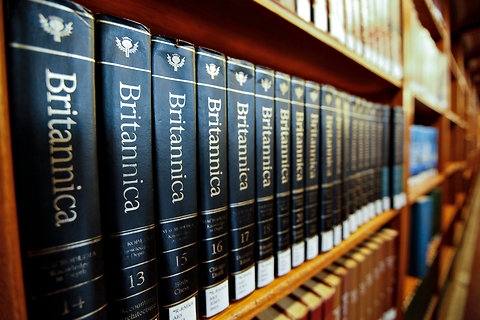
    After 244 years, the Encyclopaedia Britannica is going out of print.Those coolly authoritative, gold-lettered reference books that were once sold door-to-door by a fleet of traveling salesmen and displayed as proud fixtures in American homes will be discontinued, company executives said.

    In an acknowledgment of the realities of the digital age — and of competition from the Web site Wikipedia — Encyclopaedia Britannica will focus primarily on its online encyclopedias and educational curriculum for schools. The last print version is the 32-volume 2010 edition, which weighs 129 pounds and includes new entries on global warming and the Human Genome Project.

    “It’s a rite of passage in this new era,” Jorge Cauz, the president of Encyclopaedia Britannica Inc., a company based in Chicago, said in an interview. “Some people will feel sad about it and nostalgic about it. But we have a better tool now. The Web site is continuously updated, it’s much more expansive and it has multimedia.”

    In the 1950s, having the Encyclopaedia Britannica on the bookshelf was akin to a station wagon in the garage or a black-and-white Zenith in the den, a possession coveted for its usefulness and as a goalpost for an aspirational middle class. Buying a set was often a financial stretch, and many families had to pay for it in monthly installments.

    But in recent years, print reference books have been almost completely overtaken by the Internet and its vast spread of resources, including specialized Web sites and the hugely popular — and free — online encyclopedia Wikipedia.

    Since it was started 11 years ago, Wikipedia has moved a long way toward replacing the authority of experts with the wisdom of the crowds. The site is now written and edited by tens of thousands of contributors around the world, and it has been gradually accepted as a largely accurate and comprehensive source, even by many scholars and academics.

    Wikipedia also regularly meets the 21st-century mandate of providing instantly updated material. And it has nearly four million articles in English, including some on pop culture topics that would not be considered worthy of a mention in the Encyclopaedia Britannica.

    Mr. Cauz said that he believed Britannica’s competitive advantage with Wikipedia came from its prestigious sources, its carefully edited entries and the trust that was tied to the brand.

    “We have very different value propositions,” Mr. Cauz said. “Britannica is going to be smaller. We cannot deal with every single cartoon character, we cannot deal with every love life of every celebrity. But we need to have an alternative where facts really matter. Britannica won’t be able to be as large, but it will always be factually correct.”

    But one widely publicized study, published in 2005 by Nature, called into question Britannica’s presumed accuracy advantage over Wikipedia. The study said that out of 42 competing entries, Wikipedia made an average of four errors in each article, and Britannica three. Britannica responded with a lengthy rebuttal saying the study was error-laden and “completely without merit.”

    The Britannica, the oldest continuously published encyclopedia in the English language, has become a luxury item with a $1,395 price tag. It is frequently bought by embassies, libraries and research institutions, and by well-educated, upscale consumers who felt an attachment to the set of bound volumes. Only 8,000 sets of the 2010 edition have been sold, and the remaining 4,000 have been stored in a warehouse until they are bought.

    The 2010 edition had more than 4,000 contributors, including Arnold Palmer (who wrote the entry on the Masters tournament) and Panthea Reid, professor emeritus at Louisiana State University and author of the biography “Art and Affection: A Life of Virginia Woolf” (who wrote about Virginia Woolf).

    Sales of the Britannica peaked in 1990, when 120,000 sets were sold in the United States. But now print encyclopedias account for less than 1 percent of the Britannica’s revenue. About 85 percent of revenue comes from selling curriculum products in subjects like math, science and the English language; 15 percent comes from subscriptions to the Web site, the company said.

    About half a million households pay a $70 annual fee for the online subscription, which includes access to the full database of articles, videos, original documents and to the company’s mobile applications. At least one other general-interest encyclopedia in the United States, the World Book, is still printing a 22-volume yearly edition, said Jennifer Parello, a spokeswoman for World Book Inc. She declined to provide sales figures but said the encyclopedia was bought primarily by schools and libraries.

    Gary Marchionini, the dean of the School of Information and Library Science at the University of North Carolina at Chapel Hill, said the fading of print encyclopedias was “an inexorable trend that will continue.”

    “There’s more comprehensive material available on the Web,” Mr. Marchionini said. “The thing that you get from an encyclopedia is one of the best scholars in the world writing a description of that phenomenon or that object, but you’re still getting just one point of view. Anything worth discussing in life is worth getting more than one point of view.”

    Many librarians say that while they have rapidly shifted money and resources to digital materials, print still has a place. Academic libraries tend to keep many sets of specialized encyclopedias on their shelves, like volumes on Judaica, folklore, music or philosophy, or encyclopedias that are written in foreign languages and unavailable online.

    At the Portland Public Library in Maine, there are still many encyclopedias that the library orders on a regular basis, sometimes every year, said Sonya Durney, a reference librarian. General-interest encyclopedias are often used by students whose teachers require them to occasionally cite print sources, just to practice using print.

    “They’re used by anyone who’s learning, anyone who’s new to the country, older patrons, people who aren’t comfortable online,” Ms. Durney said. “There’s a whole demographic of people who are more comfortable with print.”

    But many people are discovering that the books have outlived their usefulness. Used editions of encyclopedias are widely available on Craigslist and eBay: more than 1,400 listings for Britannica products were posted on eBay this week.

    Charles Fuller, a geography professor who lives in the Chicago suburbs, put his 1992 edition on sale on Craigslist last Sunday. For years, he has neglected the print encyclopedias, he said in an interview, and now prefers to use his iPhone to look up facts quickly. He and his wife are downsizing and relocating to California, he said, and the Encyclopaedia Britannica will not be coming with them, a loss he acknowledges with a hint of wistfulness.

    “They’re not obsolete,” Mr. Fuller said. “When I’m doing serious research, I still use the print books. And they look really beautiful on the bookshelves.”

    • Connecting you with the world of travel and tourism

      Media Partners

      Asia Amusement & Attractions Expo 2026

      Theme Park Expo Vietnam 2025

      Asia Pool & Spa Expo , May 10 – 12, 2025 , Guangzhou , China

      KAZAKHSTAN International Exhibition “Tourism & Travel” Almaty, Kazakhstan

      Nihao China- Beyond your imagination

      China extends visa-free

      policy to UK, Canada

      China has decided to extend its visa waiver policy to ordinary passport holders from Canada and the United Kingdom starting Tuesday, when the Chinese New Year begins, a Foreign Ministry spokesperson announced on , saying the move aims to further facilitate cross-border travel.

      According to the spokesperson, ordinary passport holders from the two countries can enter China without visa and stay for up to 30 days for business, tourism, family/friends visit, exchange and transit purposes.The policy will be effective until Dec 31.

      Air India Orders 30

      Boeing 737 MAX Jets

      Air India  has ordered 30 more fuel-efficient 737 MAX jets, expanding its Boeing order book to nearly 200 airplanes across the company’s single-aisle and widebody airplane families. Boeing and Air India  announced an order for 30 fuel-efficient 737 MAX jets at the annual Wings Airshow in Hyderabad.

      The airline finalized an incremental purchase of 20 737-8 jets this month and an order for 10 737-10 airplanes was previously unidentified on Boeing’s Orders & Deliveries website. Both purchases exercised existing options as Air India expands its route network to meet rising travel demand.

      Air India will operate the new 737-8s, leveraging their dispatch reliability, fuel efficiency and range flexibility on high-frequency, domestic and short-haul regional routes. The airline also plans to deploy the larger 737-10 to maintain operational commonality and carry more passengers at the lowest cost per seat among single-aisle aircraft.

      As Air India expands its fleet and network, Boeing’s Commercial Market Outlook forecasts the Indian and South Asian region will need nearly 3,300 new airplanes over the next two decades with 90% of those single-aisle jets like the 737 MAX. ( February 2 , 2026 )

      WTTC chooses  Madrid

      for new Global Office

      London, UK: The World Travel & Tourism Council (WTTC) announced that its Operating Committee has unanimously approved Madrid in Spain as the location for the organisation’s new Global Office.

      Five destinations expressed interest in hosting the Global Office – Dubai (UAE), France, Italy, Spain and Switzerland – with the evaluation criteria based on six areas: office rental and operating costs; the tax, incentives and competitive environment; fast-track visas and work permit frameworks in the destination; government support; cost of living to attract and retain talent; and proximity to international organisations.

      The decision to choose Madrid was endorsed by all 17 members of WTTC’s Operating Committee, following a comprehensive assessment of WTTC’s long-term strategic and operational needs. Members agreed that Madrid offered the most attractive option due to the city’s competitiveness, a more favourable tax environment, government support, easier visa processing for employees and overall lower operating costs. Challenges linked to Brexit, such as constraints on talent mobility, made the UK less attractive as WTTC wishes to further build its leadership position and become even more agile in the sector.

      Madrid was also selected for its strong international connectivity via Madrid-Barajas Airport, competitive business environment, incentives from government, synergies with international organisations in the sector such as UN Tourism and alignment with WTTC’s global mission. The new office will form a central part of WTTC’s worldwide network, supporting its highly-respected advocacy, research and member engagement activities across the globe.

      Bangkok named Asia’s best

      holiday destination for 2025

      Bangkok has been ranked as the best city to visit in Asia for 2025 by Smart Travel Asia, a leading digital travel magazine, based on the opinions of hundreds of thousands of travellers and readers worldwide.

      The city received the highest votes in the “Best Holiday Destination in Asia” category, retaining its top position for the second consecutive year.

      Smart Travel Asia highlighted Bangkok’s strengths as its 24-hour vibrancy and diverse experiences, including food, culture, shopping, and the friendliness of its people, describing it as a “city full of energy and colour, day and night.”

      The city’s dominance stems from several compelling factors. Bangkok has emerged as a paradise for food enthusiasts, offering everything from legendary street food stalls to Michelin-starred restaurants and panoramic 360-degree rooftop bars. Its cultural and heritage sites, including the iconic Wat Phra Kaew, Wat Arun, and Wat Pho temples, remain major attractions to international tourists.

      Additionally, from luxury malls in the city centre to the Chatuchak weekend market, Bangkok caters to every type of shopper. Affordability and friendliness also play a key role, as Bangkok remains an accessible living cost destination where welcoming smiles continue to charm travellers.

      In the Smart Travel Asia 2025 rankings, Bali (Indonesia) and Tokyo (Japan) shared second place behind Bangkok, while Seoul (the Republic of Korea) and Luang Prabang (Laos) tied for fourth. Thailand further strengthened its tourism appeal with Chiang Mai placing third and Phuket sharing fifth place with Hong Kong (China).

      Having the three cities, Bangkok, Chiang Mai, and Phuket, in the top 10 highlights the diversity and appeal of Thailand’s tourism offerings for travellers worldwide. — VNA/VNS ( Oct.12, 2025)

      Gulf Cooperation Council Tourism 

      Dubai – As tourism destinations in the Gulf Cooperation Council (GCC) continue to grow, involving local communities in destination development has become increasingly vital for long-term success.

      Abu Dhabi’s Tourism Strategy 2030 aims for 39.3 million visitors per year, while Saudi Arabia’s Vision 2030 targets 150 million domestic and international visits, emphasising how tourism is being established as a key element of economic diversification throughout the region.

      At Arabian Travel Market (ATM) 2025, industry leaders emphasised that sustainable revitalisation of destinations must align tourism investments with community partnerships, cultural authenticity, and immersive guest experiences to provide lasting value for both residents and visitors.

      During the session on “Considerations and Implications of Involving Communities in Destination Revitalisation” on the ATM 2025 Global Stage, experts shared insights into building resilience, enhancing local prosperity, and ensuring tourism growth is both inclusive and enduring.

      Arabian Travel Market 2025, held under the theme “Global Travel: Developing Tomorrow’s Tourism Through Enhanced Connectivity”,  featured more than 200 speakers across three content stages and welcomes over 55,000 travel professionals from 166 countries.

      Messe Berlin India launched 

      to drive growth of ITB India 

      Messe Berlin announces the official launch of Messe Berlin India, a newly incorporated subsidiary that underscores the company’s long-term commitment to one of Asia’s fastest-growing markets. Headquartered in Delhi , the new entity will serve as a strategic base for expanding ITB India and launching future projects tailored to the Indian market. With this establishment, Messe Berlin is reinforcing its vision of India as a regional hub for innovation, collaboration, and sustainable business growth within the exhibition and events industry.

      “Messe Berlin’s presence in India reflects our strategic intent to strengthen our international reach by being where the growth is. India is a key market for us — vibrant, diverse, and full of opportunities. With Messe Berlin India, we are laying down long-term foundations to build strong partnerships, support local industries, and elevate our global platforms,” said Dr. Mario Tobias, CEO, Messe Berlin.

      ITB India, inaugurated in 2023, continues as the flagship event under the new subsidiary. Held annually, ITB India is a three-day B2B travel trade show and convention that connects the global travel and tourism industry with the Indian market. Alongside MICE Show India, Travel Tech India, and the ITB India Conference, ITB India serves as a unique platform to forge new partnerships, strengthen existing ties, and capitalize on the fast-growing potential of the Indian and South Asian travel economies. The show hosts key players from the MICE, Leisure, Corporate Travel, and Travel Technology sectors. The upcoming edition, ITB India 2025, will take place from 2 – 4 September 2025  in Mumbai.

      FACTS —

      Tourism helps in:

      👉Reducing poverty

      👉Reducing Inequalities

      👉Promoting gender equality

      👉Fostering decent work and economic growth

      World Tourism Day 2021: ‘Tourism for Inclusive Growth’

      In 2019, Travel & Tourism’s direct, indirect and induced impact accounted for:
      -US$8.9 trillion contribution to the world’s GDP
      -10.3% of global GDP
      -330 million jobs, 1 in 10 jobs around the world
      -US$1.7 trillion visitor exports (6.8% of total exports,
      28.3% of global services exports)
      -US$948 billion capital investment (4.3% of total
      investment)