• Are Humans Responsible for the Himalayan Tsunami?
    July 1, 2013
    Are Humans Responsible for the Himalayan Tsunami?

    By Sujoy Dhar ——

    NEW DELHI, Jun 27 2013 (IPS) – On the outskirts of Rudraprayag, a town in the northern Indian state of Uttarakhand whose many temples draw tourists and Hindu pilgrims with magnetic force, visitors often stop for a meal at a popular hotel built right on the river Alakananda.

    One of the two head streams of the Ganga, the holy lifeline of India that gushes from the Gomukh snout of the massive Gangotri glacier in the Himalayas, Alakananda is revered as a goddess.

    A night in the hotel is cheap, and budget tourists from home and abroad come here for the breathtaking view from balconies overlooking the mountains and glaciers that comprise 90 percent of the state.

    As idyllic as it sounds, this hotel unwittingly played a role in one of the worst natural disasters the state has ever seen when, on Jun. 15, flash floods caused by a cloudburst and glacial leaks swept thousands of unsuspecting pilgrims away in what scientists are now referring to as a ‘Himalayan tsunami’.

    The state’s chief minister said  that the death toll could exceed 1,000, with 300 bodies found just this morning buried beneath silt beside the largest temple in the town of Kedarnath.

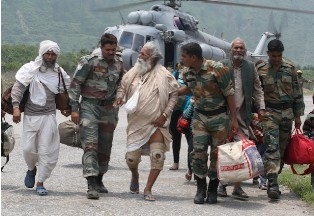
    Countless tourists were trapped for days in pitiable conditions until the Indian Defence Force came to their rescue in one aerial sortie after another.

    Thousands are still missing and many towns and pilgrimage sites remain inaccessible, as the raging waters carried away whole strips of roads, along with homes, shops and hapless victims.

    As the government scrambles to complete a haphazard rescue operation, environmentalists are taking a step back, pointing out that the disaster was not simply a freak natural hazard but a result of unbridled development in the Land of the Gods.

    Hydropower projects

    For years, a booming tourist industry, made possible by thousands of illegally constructed guesthouses, has spawned massive hydroelectric power projects on the rivers, while other infrastructure development designed to accommodate hoards of visitors has proceeded at a steady clip, putting undue stress on this fragile ecological zone.

    Scientists also say the damming of the Ganga, riverbed encroachment and mining activities are wreaking havoc on the region.

    “There (have been) no credible environmental or social impact assessments for hundreds of projects,” Himanshu Thakkar, coordinator of the South Asia Network on Dams, Rivers and People, tells IPS.

    According to Mallika Bhanot, member of Ganga Ahvaan, a public forum to save the holy river, about 244 dams are being constructed along the water channel, while only three were cancelled after a 100-km stretch, from the glacial mouth of Gomukh to Uttarkashi town, was declared an eco-sensitive zone (ESZ) in December 2012.

    “Even that notification by the government in New Delhi has been opposed by the Uttarakhand government,” Bhanot tells IPS, despite the fact that it was designed after a thorough assessment of the topography, and with the intention of preserving human lives in a landslide-prone zone.

    Frightening footage of the recent disaster captured multi-storey buildings collapsing into the river like a pack of cards, while cars, bridges and shops were easily swept into the vortex. Activists say all of this could have been prevented if the state government had heeded the call to cease construction and encroachment on the riverbed.

    The New Delhi-based Centre for Science and Environment (CSE) has also traced the link between the disaster and the manner in which development has been carried out in this unique region.

    Acknowledging the economic importance of energy generation, CSE Director-General Sunita Narain questions whether or not “the Central or state government ever considered the cumulative impact of the hydropower projects on the rivers and the mountains.”

    “Currently, there are roughly 70 projects built or (slated to be built) on the Ganga, expected to generate some 10,000 megawatts (MW) of power,” she told IPS.

    She referred to this model as “bumper to bumper development”, with one project immediately following another.

    Diversion channels and reservoirs will affect 80 percent of the Bhagirathi, the Ganga’s second head stream, and 65 percent of the Alakananda, Narain stressed. During the dry season, large stretches of the river will be completely dry.

    Such activities, she said, are fantastically lucrative for developers, making it next to impossible for small environmental groups to have their voices heard.

    “There is a strong construction lobby in Uttarakhand,” said Bhanot, adding that many politicians’ election funds come directly from hydropower projects.

    Green alternatives abound, including electricity generation using smoke from burning pine needles to propel turbines; biomass; or mini hydro plants, capable of generating two MW of power. But these, less profitable schemes do not sit well with corporations.

    Narain says this particular disaster cannot be attributed solely to climate change, but the growing trend of intense and extreme weather events – particularly a heavier, more unpredictable monsoon – is undeniable.

    With climate change widely acknowledged to be the result of the burning of fossil fuels and emission of excessive carbon dioxide into the atmosphere, it is clear that the ongoing tragedy is human-induced, Thakkar said.

    The glacial lake outburst flood (GLOF) that poured down the mountains bringing boulders and rocks is just another sign that the delicate balance of nature’s forces has been disrupted – and Uttarakhand is paying the price.

    Regulation required

    Tourism may form the backbone of Uttarakhand’s economy, but it is now clear that visitors and pilgrims number too many: according to government data, 42.2 million domestic tourists and 227,000 foreigners flocked to Uttarakhand in 2012.

    Those numbers are expected to double by 2017, with the state gearing up to welcome 77.7 million domestic travelers and nearly 400,000 foreigners.

    These arrivals will be accompanied not only by increased human waste and pollution from transport, but also by endless construction of hotels and the justification of ever more mega development projects.

    Experts like Thakkar insist that the sector be regulated based on a proper scientific assessment of the region.

    This will not be easy, since tourism brings much-needed revenue to the state. The government estimates that each tourist spends an average of 38 dollars a day, much of which goes directly to the government via entrance fees for religious sites.

    But while this income from “religious and cultural tourism is a lifeline for many, it will not be sustainable…(unless) all development activities take into account the vulnerability of the area,” Thakkar says.

    The youngest mountain range in the world, the Himalayas are already prone to erosion, landslides and seismic activity.

    “Development cannot come at the cost of the environment in any region of the country; but particularly not in the Himalayas,” Narain stressed.


    • Connecting you with the world of travel and tourism

      Media Partners

      Asia Amusement & Attractions Expo 2026

      Theme Park Expo Vietnam 2025

      Asia Pool & Spa Expo , May 10 – 12, 2025 , Guangzhou , China

      KAZAKHSTAN International Exhibition “Tourism & Travel” Almaty, Kazakhstan

      Nihao China- Beyond your imagination

      Zhejiang Province , China

      Bangkok named Asia’s best

      holiday destination for 2025

      Bangkok has been ranked as the best city to visit in Asia for 2025 by Smart Travel Asia, a leading digital travel magazine, based on the opinions of hundreds of thousands of travellers and readers worldwide.

      The city received the highest votes in the “Best Holiday Destination in Asia” category, retaining its top position for the second consecutive year.

      Smart Travel Asia highlighted Bangkok’s strengths as its 24-hour vibrancy and diverse experiences, including food, culture, shopping, and the friendliness of its people, describing it as a “city full of energy and colour, day and night.”

      The city’s dominance stems from several compelling factors. Bangkok has emerged as a paradise for food enthusiasts, offering everything from legendary street food stalls to Michelin-starred restaurants and panoramic 360-degree rooftop bars. Its cultural and heritage sites, including the iconic Wat Phra Kaew, Wat Arun, and Wat Pho temples, remain major attractions to international tourists.

      Additionally, from luxury malls in the city centre to the Chatuchak weekend market, Bangkok caters to every type of shopper. Affordability and friendliness also play a key role, as Bangkok remains an accessible living cost destination where welcoming smiles continue to charm travellers.

      In the Smart Travel Asia 2025 rankings, Bali (Indonesia) and Tokyo (Japan) shared second place behind Bangkok, while Seoul (the Republic of Korea) and Luang Prabang (Laos) tied for fourth. Thailand further strengthened its tourism appeal with Chiang Mai placing third and Phuket sharing fifth place with Hong Kong (China).

      Having the three cities, Bangkok, Chiang Mai, and Phuket, in the top 10 highlights the diversity and appeal of Thailand’s tourism offerings for travellers worldwide. — VNA/VNS ( Oct.12, 2025)

      India resumes tourist visa for

      Chinese citizens after 5 years

      India announced  that it will open tourist visa applications to Chinese citizens from July 24, 2025. It was the first time in five years since the South Asian country suspended Chinese citizens’ tourist visa applications in February 2020.

      The Embassy of India in China announced via its Sina Weibo account  that, starting from July 24, 2025, Chinese citizens can apply for a tourist visa to visit India after completing an online application, scheduling an appointment, and personally submitting their passport and other required documents to three Indian visa application centers in Beijing, Shanghai, and Guangzhou in South China’s Guangdong Province.

      Responding to the related inquiry, Chinese Foreign Ministry spokesperson Guo Jiakun said  that “we take note of this positive move. Easing cross-border travel is widely beneficial. China will maintain communication and consultation with India to further facilitate travel between the two countries.”

      Chinese experts said the latest move taken by the India marks a phased milestone in the easing of relations between the two countries, and creates favorable conditions for further strengthening bilateral people-to-people exchanges.

      On February 2, 2020, India temporarily suspended its e-visa facility for Chinese travelers and foreigners residing in China amid coronavirus outbreak. – Global Times

      Gulf Cooperation Council Tourism 

      Dubai – As tourism destinations in the Gulf Cooperation Council (GCC) continue to grow, involving local communities in destination development has become increasingly vital for long-term success.

      Abu Dhabi’s Tourism Strategy 2030 aims for 39.3 million visitors per year, while Saudi Arabia’s Vision 2030 targets 150 million domestic and international visits, emphasising how tourism is being established as a key element of economic diversification throughout the region.

      At Arabian Travel Market (ATM) 2025, industry leaders emphasised that sustainable revitalisation of destinations must align tourism investments with community partnerships, cultural authenticity, and immersive guest experiences to provide lasting value for both residents and visitors.

      During the session on “Considerations and Implications of Involving Communities in Destination Revitalisation” on the ATM 2025 Global Stage, experts shared insights into building resilience, enhancing local prosperity, and ensuring tourism growth is both inclusive and enduring.

      Arabian Travel Market 2025, held under the theme “Global Travel: Developing Tomorrow’s Tourism Through Enhanced Connectivity”,  featured more than 200 speakers across three content stages and welcomes over 55,000 travel professionals from 166 countries.

      Messe Berlin India launched 

      to drive growth of ITB India 

      Messe Berlin announces the official launch of Messe Berlin India, a newly incorporated subsidiary that underscores the company’s long-term commitment to one of Asia’s fastest-growing markets. Headquartered in Delhi , the new entity will serve as a strategic base for expanding ITB India and launching future projects tailored to the Indian market. With this establishment, Messe Berlin is reinforcing its vision of India as a regional hub for innovation, collaboration, and sustainable business growth within the exhibition and events industry.

      “Messe Berlin’s presence in India reflects our strategic intent to strengthen our international reach by being where the growth is. India is a key market for us — vibrant, diverse, and full of opportunities. With Messe Berlin India, we are laying down long-term foundations to build strong partnerships, support local industries, and elevate our global platforms,” said Dr. Mario Tobias, CEO, Messe Berlin.

      ITB India, inaugurated in 2023, continues as the flagship event under the new subsidiary. Held annually, ITB India is a three-day B2B travel trade show and convention that connects the global travel and tourism industry with the Indian market. Alongside MICE Show India, Travel Tech India, and the ITB India Conference, ITB India serves as a unique platform to forge new partnerships, strengthen existing ties, and capitalize on the fast-growing potential of the Indian and South Asian travel economies. The show hosts key players from the MICE, Leisure, Corporate Travel, and Travel Technology sectors. The upcoming edition, ITB India 2025, will take place from 2 – 4 September 2025  in Mumbai.

      FACTS —

      Tourism helps in:

      👉Reducing poverty

      👉Reducing Inequalities

      👉Promoting gender equality

      👉Fostering decent work and economic growth

      World Tourism Day 2021: ‘Tourism for Inclusive Growth’

      In 2019, Travel & Tourism’s direct, indirect and induced impact accounted for:
      -US$8.9 trillion contribution to the world’s GDP
      -10.3% of global GDP
      -330 million jobs, 1 in 10 jobs around the world
      -US$1.7 trillion visitor exports (6.8% of total exports,
      28.3% of global services exports)
      -US$948 billion capital investment (4.3% of total
      investment)

      Tibet Travel : Daily Life of Living under Mount Everest