• SCO Summit : China’s Global Governance Initiative aims to inject greater stability
    September 2, 2025
    SCO Summit : China’s Global Governance Initiative aims to inject greater stability

    Tianjin( CGTN) -China proposed the Global Governance Initiative (GGI), another important public good that China has shared with the world to promote building a more just and reasonable global governance system.

    The GGI marks the fourth landmark global initiative proposed by Chinese President Xi Jinping over the past several years, following the Global Development Initiative, the Global Security Initiative and the Global Civilization Initiative.

    “I look forward to working with all countries for a more just and equitable global governance system and advancing toward a community with a shared future for humanity,” Chinese President Xi Jinping said upon putting forward the proposal during the “Shanghai Cooperation Organization (SCO) Plus” Meeting.

    During the two-day SCO Summit in north China’s Tianjin, where the organization held the largest summit in its 24-year history, attended by leaders from more than 20 countries and heads of 10 international organizations, Xi has delivered two important speeches, expounding on the organization’s growing international influence and appeal and urging the need to maintain international fairness and justice.

    Xi highlighted five principles of the GGI: adhering to sovereign equality, abiding by international rule of law, practicing multilateralism, advocating the people-centered approach, and focusing on taking real actions. “All countries, regardless of size, strength and wealth, are equal participants, decision-makers and beneficiaries in global governance,” he noted.

    “Today, the world is confronted with increasingly complex and diverse challenges such as terrorism, the refugee crisis and transnational crime. While the historical trends of peace, development, cooperation and mutual benefit remain unchanged, the Cold War mentality, hegemonism and protectionism continue to haunt the world.”

    No country can be immune to these challenges. “History tells us that at difficult times, we must uphold our original commitment to peaceful coexistence, strengthen our confidence in win-win cooperation, advance in line with the trend of history, and thrive in keeping pace with the times,” he said.

    Amid shifting global landscapes, the SCO has been contributing to the improvement of global governance by promoting a new type of international relations grounded in mutual respect, fairness and win-win cooperation.

    For years, China has advocated a vision of global governance that features extensive consultation and joint contribution for shared benefit, and has contributed Chinese wisdom and public goods to solving the pressing problems now facing humanity.

    From the concept of building a community with a shared future for humanity to the proposals of the three global initiatives and the Belt and Road Initiative, China’s ideas have illuminated the path forward as the world seeks sustainable and inclusive development.

    Over the past 24 years, guided by the Shanghai Spirit of mutual trust, mutual benefit, equality, consultation, respect for the diversity of civilizations, and the pursuit of common development, the SCO member states have shared opportunities, sought common development, and brought about groundbreaking and historic achievements.

    The SCO was the first to take multilateral actions against the three forces of terrorism, separatism and extremism. The member states have foiled more than 1,400 terrorism- and extremism-related cases so far, helping anchor security across the region.

    Through deepened cooperation with the United Nations and other international organizations, and by playing a constructive role in international and regional affairs, the SCO champions inclusiveness and mutual learning between civilizations and opposes hegemonism and power politics, thus becoming a proactive force for world peace and development.

    Highlighting that the SCO has increasingly become a catalyst for the development and reform of the global governance system, Xi urged the SCO to step up, play a leading role and set an example in carrying out the GGI.

    He vowed that China will readily share the opportunities of its vast market and continue to implement the action plan for high-quality development of economic and trade cooperation within the SCO family.

    1 September 2025

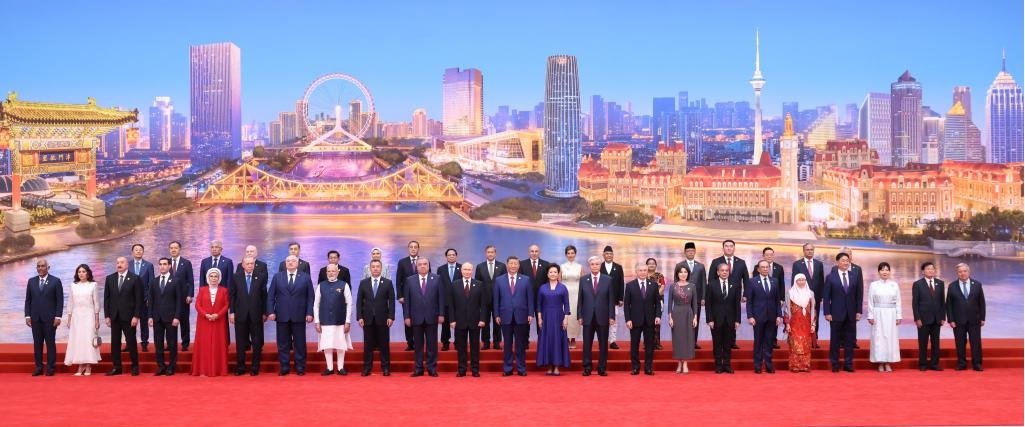
    Photo : Chinese President Xi Jinping and his wife, Peng Liyuan, pose for a group photo with international guests before a welcoming banquet at the Meijiang Convention and Exhibition Center in Tianjin, north China, Aug. 31, 2025. (Xinhua/Huang Jingwen)

    (Note : The Shanghai Cooperation Organization (SCO) was established on June 15, 2001, with its founding members being China, Russia, Kazakhstan, Kyrgyzstan, Tajikistan, and Uzbekistan. In 2017, India and Pakistan joined the SCO. In 2023, Iran became a member, followed by Belarus in 2024, bringing the total number of SCO member states to 10.

    The SCO has two observer states—Afghanistan and Mongolia—and 14 dialogue partners, including Azerbaijan, Armenia, Cambodia, Nepal, Türkiye, Sri Lanka, Saudi Arabia, Egypt, Qatar, Bahrain, the Maldives, Myanmar, the United Arab Emirates, and Kuwait.

    The supreme decision-making body of the SCO is the Council of Heads of States (CHS). It meets once a year and is hosted by the rotating presidency country.The Council of Heads of Government (Prime Ministers) (CHG) is an important meeting mechanism within the SCO. It meets once a year.Additionally, the SCO framework includes various meeting mechanisms covering areas such as foreign affairs, national defense, security, economy and trade, culture, health, education, transport, emergency prevention and relief, science and technology, agriculture, the judiciary, tourism, and national coordination.- Editor )

    • Connecting you with the world of travel and tourism

      Media Partners

      Asia Amusement & Attractions Expo 2026

      Theme Park Expo Vietnam 2025

      Asia Pool & Spa Expo , May 10 – 12, 2025 , Guangzhou , China

      KAZAKHSTAN International Exhibition “Tourism & Travel” Almaty, Kazakhstan

      Nihao China- Beyond your imagination

      Zhejiang Province , China

      Bangkok named Asia’s best

      holiday destination for 2025

      Bangkok has been ranked as the best city to visit in Asia for 2025 by Smart Travel Asia, a leading digital travel magazine, based on the opinions of hundreds of thousands of travellers and readers worldwide.

      The city received the highest votes in the “Best Holiday Destination in Asia” category, retaining its top position for the second consecutive year.

      Smart Travel Asia highlighted Bangkok’s strengths as its 24-hour vibrancy and diverse experiences, including food, culture, shopping, and the friendliness of its people, describing it as a “city full of energy and colour, day and night.”

      The city’s dominance stems from several compelling factors. Bangkok has emerged as a paradise for food enthusiasts, offering everything from legendary street food stalls to Michelin-starred restaurants and panoramic 360-degree rooftop bars. Its cultural and heritage sites, including the iconic Wat Phra Kaew, Wat Arun, and Wat Pho temples, remain major attractions to international tourists.

      Additionally, from luxury malls in the city centre to the Chatuchak weekend market, Bangkok caters to every type of shopper. Affordability and friendliness also play a key role, as Bangkok remains an accessible living cost destination where welcoming smiles continue to charm travellers.

      In the Smart Travel Asia 2025 rankings, Bali (Indonesia) and Tokyo (Japan) shared second place behind Bangkok, while Seoul (the Republic of Korea) and Luang Prabang (Laos) tied for fourth. Thailand further strengthened its tourism appeal with Chiang Mai placing third and Phuket sharing fifth place with Hong Kong (China).

      Having the three cities, Bangkok, Chiang Mai, and Phuket, in the top 10 highlights the diversity and appeal of Thailand’s tourism offerings for travellers worldwide. — VNA/VNS ( Oct.12, 2025)

      India resumes tourist visa for

      Chinese citizens after 5 years

      India announced  that it will open tourist visa applications to Chinese citizens from July 24, 2025. It was the first time in five years since the South Asian country suspended Chinese citizens’ tourist visa applications in February 2020.

      The Embassy of India in China announced via its Sina Weibo account  that, starting from July 24, 2025, Chinese citizens can apply for a tourist visa to visit India after completing an online application, scheduling an appointment, and personally submitting their passport and other required documents to three Indian visa application centers in Beijing, Shanghai, and Guangzhou in South China’s Guangdong Province.

      Responding to the related inquiry, Chinese Foreign Ministry spokesperson Guo Jiakun said  that “we take note of this positive move. Easing cross-border travel is widely beneficial. China will maintain communication and consultation with India to further facilitate travel between the two countries.”

      Chinese experts said the latest move taken by the India marks a phased milestone in the easing of relations between the two countries, and creates favorable conditions for further strengthening bilateral people-to-people exchanges.

      On February 2, 2020, India temporarily suspended its e-visa facility for Chinese travelers and foreigners residing in China amid coronavirus outbreak. – Global Times

      Gulf Cooperation Council Tourism 

      Dubai – As tourism destinations in the Gulf Cooperation Council (GCC) continue to grow, involving local communities in destination development has become increasingly vital for long-term success.

      Abu Dhabi’s Tourism Strategy 2030 aims for 39.3 million visitors per year, while Saudi Arabia’s Vision 2030 targets 150 million domestic and international visits, emphasising how tourism is being established as a key element of economic diversification throughout the region.

      At Arabian Travel Market (ATM) 2025, industry leaders emphasised that sustainable revitalisation of destinations must align tourism investments with community partnerships, cultural authenticity, and immersive guest experiences to provide lasting value for both residents and visitors.

      During the session on “Considerations and Implications of Involving Communities in Destination Revitalisation” on the ATM 2025 Global Stage, experts shared insights into building resilience, enhancing local prosperity, and ensuring tourism growth is both inclusive and enduring.

      Arabian Travel Market 2025, held under the theme “Global Travel: Developing Tomorrow’s Tourism Through Enhanced Connectivity”,  featured more than 200 speakers across three content stages and welcomes over 55,000 travel professionals from 166 countries.

      Messe Berlin India launched 

      to drive growth of ITB India 

      Messe Berlin announces the official launch of Messe Berlin India, a newly incorporated subsidiary that underscores the company’s long-term commitment to one of Asia’s fastest-growing markets. Headquartered in Delhi , the new entity will serve as a strategic base for expanding ITB India and launching future projects tailored to the Indian market. With this establishment, Messe Berlin is reinforcing its vision of India as a regional hub for innovation, collaboration, and sustainable business growth within the exhibition and events industry.

      “Messe Berlin’s presence in India reflects our strategic intent to strengthen our international reach by being where the growth is. India is a key market for us — vibrant, diverse, and full of opportunities. With Messe Berlin India, we are laying down long-term foundations to build strong partnerships, support local industries, and elevate our global platforms,” said Dr. Mario Tobias, CEO, Messe Berlin.

      ITB India, inaugurated in 2023, continues as the flagship event under the new subsidiary. Held annually, ITB India is a three-day B2B travel trade show and convention that connects the global travel and tourism industry with the Indian market. Alongside MICE Show India, Travel Tech India, and the ITB India Conference, ITB India serves as a unique platform to forge new partnerships, strengthen existing ties, and capitalize on the fast-growing potential of the Indian and South Asian travel economies. The show hosts key players from the MICE, Leisure, Corporate Travel, and Travel Technology sectors. The upcoming edition, ITB India 2025, will take place from 2 – 4 September 2025  in Mumbai.

      FACTS —

      Tourism helps in:

      👉Reducing poverty

      👉Reducing Inequalities

      👉Promoting gender equality

      👉Fostering decent work and economic growth

      World Tourism Day 2021: ‘Tourism for Inclusive Growth’

      In 2019, Travel & Tourism’s direct, indirect and induced impact accounted for:
      -US$8.9 trillion contribution to the world’s GDP
      -10.3% of global GDP
      -330 million jobs, 1 in 10 jobs around the world
      -US$1.7 trillion visitor exports (6.8% of total exports,
      28.3% of global services exports)
      -US$948 billion capital investment (4.3% of total
      investment)

      Tibet Travel : Daily Life of Living under Mount Everest