• Nepal marks one year since quake as frustration mounts
    April 24, 2016
    Nepal marks one year since quake as frustration mounts

    Kathmandu : Nepal held memorial services on Sunday for the thousands killed in a massive earthquake one year ago, as victims still living in tents accused the government of failing them.

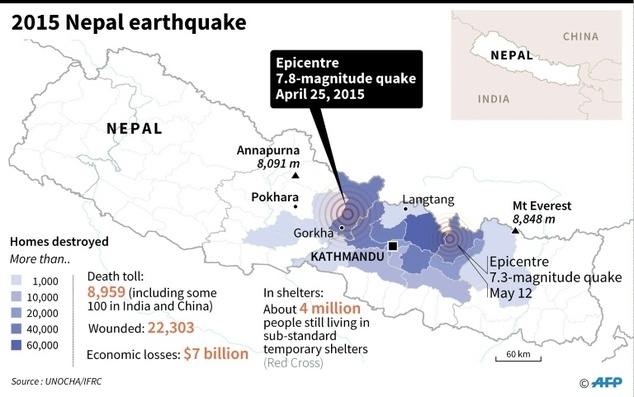
    The 7.8-magnitude quake killed nearly 9,000 people and some four million survivors are still living in temporary shelters, according to the International Federation of Red Cross and Red Crescent Societies.

    Prime Minister K.P. Sharma Oli laid flowers at a razed 19th-century tower in Kathmandu where hundreds gathered for a sombre service, after a minute’s silence to remember those killed.

    Buddhist monks in maroon robes held prayers at a site nearby that was home to a popular temple destroyed in the quake.

    Trekking guide Govinda Timilsina said his life has been on hold since losing his home, as he waits for help and unable to rebuild himself because of the government’s complex rules for qualifying for quake aid.

    “It became impossible to live in the village, we lost everything,” Timilsina, 28, said of having to relocate his mother, wife and three-year-old son from hard-hit Dhading district.

    “The government rules were so confusing, we were scared we would not get compensation if we started work on our own,” said Timilsina, who rents a single room in Kathmandu for his family.

    A child runs near a demolished earthquake-damaged home in Dolakha as hundreds of thousands of Nepali earthquake survivors still languish in temporary shelters one year after the disaster

    Although international donors pledged $4.1 billion to aid Nepal’s recovery, political wrangling over control of the funds means most victims have received nothing beyond an initial small payout.

    Following a hailstorm of criticism, the government has vowed to kickstart reconstruction of schools and hospitals, and speed up handing out the first $500 instalment of a $2,000 payout promised to homeless survivors.

    But in the capital on Sunday, about 20 people dressed in black protested against the government’s response to the tragedy, chanting “politicians in palaces, public in tents” and “what happened to reconstruction?”

    The disaster reduced more than a hundred monuments to rubble and damaged another 560 structures, including many centuries-old temples and stunning royal palaces in the Kathmandu valley that used to attract visitors from around the world.

    In the historic town of Bhaktapur, many of the traditional brick houses that made it famous have been replaced by grey tents and rusty tin shacks where women like Laxmi Nyapit are now forced to raise their children.

    Rescue personnel search for survivors after an earthquake in Bhaktapur, on the outskirts of Kathmandu, on April 27, 2015 (top) and the same spot seen on April 22, 2016

    “Unless we get help, I don’t know how we will ever live in a house again,” the mother-of-three told AFP sitting in her tent, which houses a bed and a stove.

    Nyapit, who has received just $150 from the government, said memorials — including candlelight vigils planned for later Sunday — meant little.

    “They have to remember those who died, but first they have to remember us survivors and come here to help us,” said the 40-year-old, who earns 35 rupees (32 US cents) a day for knitting gloves.

    “If our government cared, we would not be living like this after a year.”

    Nepalese workers demolish an earthquake-damaged home in Dolakha on March 27, 2016

    The disaster struck on April 25 but commemorations were being held on Sunday — the quake anniversary according to the Nepali calendar.

    The quake wrecked infrastructure across the hardest-hit regions of Nepal, damaging more than 1,200 health centres and severing a lifeline for remote, rural communities.

    Tired of waiting, some 110,000 families have moved back into homes that remain at risk of collapse. More than 31,000 victims have also rebuilt their own houses, taking out loans or turning to charities for help.

    The disaster struck on April 25 but commemorations were being held on Sunday — the quake anniversary according to the Nepali calendar.

    The quake wrecked infrastructure across the hardest-hit regions of Nepal, damaging more than 1,200 health centres and severing a lifeline for remote, rural communities.

    Nearly 8,000 schools were destroyed or left unsafe, leaving almost one million children without classrooms.

    Tired of waiting, some 110,000 families have moved back into homes that remain at risk of collapse. More than 31,000 victims have also rebuilt their own houses, taking out loans or turning to charities for help.

    On top of the financial losses, pegged at $7 billion, the disaster also delivered a severe blow to Nepal’s already weak economy.

    Growth is now expected to reach just 1.5 percent over the financial year ending in July 2016 — the lowest level since 2007 — according to the Asian Development Bank. – AFP / April 22, 2016


    • Connecting you with the world of travel and tourism

      Media Partners

      Asia Amusement & Attractions Expo 2026

      Theme Park Expo Vietnam 2025

      Asia Pool & Spa Expo , May 10 – 12, 2025 , Guangzhou , China

      KAZAKHSTAN International Exhibition “Tourism & Travel” Almaty, Kazakhstan

      Nihao China- Beyond your imagination

      Zhejiang Province , China

      Bangkok named Asia’s best

      holiday destination for 2025

      Bangkok has been ranked as the best city to visit in Asia for 2025 by Smart Travel Asia, a leading digital travel magazine, based on the opinions of hundreds of thousands of travellers and readers worldwide.

      The city received the highest votes in the “Best Holiday Destination in Asia” category, retaining its top position for the second consecutive year.

      Smart Travel Asia highlighted Bangkok’s strengths as its 24-hour vibrancy and diverse experiences, including food, culture, shopping, and the friendliness of its people, describing it as a “city full of energy and colour, day and night.”

      The city’s dominance stems from several compelling factors. Bangkok has emerged as a paradise for food enthusiasts, offering everything from legendary street food stalls to Michelin-starred restaurants and panoramic 360-degree rooftop bars. Its cultural and heritage sites, including the iconic Wat Phra Kaew, Wat Arun, and Wat Pho temples, remain major attractions to international tourists.

      Additionally, from luxury malls in the city centre to the Chatuchak weekend market, Bangkok caters to every type of shopper. Affordability and friendliness also play a key role, as Bangkok remains an accessible living cost destination where welcoming smiles continue to charm travellers.

      In the Smart Travel Asia 2025 rankings, Bali (Indonesia) and Tokyo (Japan) shared second place behind Bangkok, while Seoul (the Republic of Korea) and Luang Prabang (Laos) tied for fourth. Thailand further strengthened its tourism appeal with Chiang Mai placing third and Phuket sharing fifth place with Hong Kong (China).

      Having the three cities, Bangkok, Chiang Mai, and Phuket, in the top 10 highlights the diversity and appeal of Thailand’s tourism offerings for travellers worldwide. — VNA/VNS ( Oct.12, 2025)

      India resumes tourist visa for

      Chinese citizens after 5 years

      India announced  that it will open tourist visa applications to Chinese citizens from July 24, 2025. It was the first time in five years since the South Asian country suspended Chinese citizens’ tourist visa applications in February 2020.

      The Embassy of India in China announced via its Sina Weibo account  that, starting from July 24, 2025, Chinese citizens can apply for a tourist visa to visit India after completing an online application, scheduling an appointment, and personally submitting their passport and other required documents to three Indian visa application centers in Beijing, Shanghai, and Guangzhou in South China’s Guangdong Province.

      Responding to the related inquiry, Chinese Foreign Ministry spokesperson Guo Jiakun said  that “we take note of this positive move. Easing cross-border travel is widely beneficial. China will maintain communication and consultation with India to further facilitate travel between the two countries.”

      Chinese experts said the latest move taken by the India marks a phased milestone in the easing of relations between the two countries, and creates favorable conditions for further strengthening bilateral people-to-people exchanges.

      On February 2, 2020, India temporarily suspended its e-visa facility for Chinese travelers and foreigners residing in China amid coronavirus outbreak. – Global Times

      Gulf Cooperation Council Tourism 

      Dubai – As tourism destinations in the Gulf Cooperation Council (GCC) continue to grow, involving local communities in destination development has become increasingly vital for long-term success.

      Abu Dhabi’s Tourism Strategy 2030 aims for 39.3 million visitors per year, while Saudi Arabia’s Vision 2030 targets 150 million domestic and international visits, emphasising how tourism is being established as a key element of economic diversification throughout the region.

      At Arabian Travel Market (ATM) 2025, industry leaders emphasised that sustainable revitalisation of destinations must align tourism investments with community partnerships, cultural authenticity, and immersive guest experiences to provide lasting value for both residents and visitors.

      During the session on “Considerations and Implications of Involving Communities in Destination Revitalisation” on the ATM 2025 Global Stage, experts shared insights into building resilience, enhancing local prosperity, and ensuring tourism growth is both inclusive and enduring.

      Arabian Travel Market 2025, held under the theme “Global Travel: Developing Tomorrow’s Tourism Through Enhanced Connectivity”,  featured more than 200 speakers across three content stages and welcomes over 55,000 travel professionals from 166 countries.

      Messe Berlin India launched 

      to drive growth of ITB India 

      Messe Berlin announces the official launch of Messe Berlin India, a newly incorporated subsidiary that underscores the company’s long-term commitment to one of Asia’s fastest-growing markets. Headquartered in Delhi , the new entity will serve as a strategic base for expanding ITB India and launching future projects tailored to the Indian market. With this establishment, Messe Berlin is reinforcing its vision of India as a regional hub for innovation, collaboration, and sustainable business growth within the exhibition and events industry.

      “Messe Berlin’s presence in India reflects our strategic intent to strengthen our international reach by being where the growth is. India is a key market for us — vibrant, diverse, and full of opportunities. With Messe Berlin India, we are laying down long-term foundations to build strong partnerships, support local industries, and elevate our global platforms,” said Dr. Mario Tobias, CEO, Messe Berlin.

      ITB India, inaugurated in 2023, continues as the flagship event under the new subsidiary. Held annually, ITB India is a three-day B2B travel trade show and convention that connects the global travel and tourism industry with the Indian market. Alongside MICE Show India, Travel Tech India, and the ITB India Conference, ITB India serves as a unique platform to forge new partnerships, strengthen existing ties, and capitalize on the fast-growing potential of the Indian and South Asian travel economies. The show hosts key players from the MICE, Leisure, Corporate Travel, and Travel Technology sectors. The upcoming edition, ITB India 2025, will take place from 2 – 4 September 2025  in Mumbai.

      FACTS —

      Tourism helps in:

      👉Reducing poverty

      👉Reducing Inequalities

      👉Promoting gender equality

      👉Fostering decent work and economic growth

      World Tourism Day 2021: ‘Tourism for Inclusive Growth’

      In 2019, Travel & Tourism’s direct, indirect and induced impact accounted for:
      -US$8.9 trillion contribution to the world’s GDP
      -10.3% of global GDP
      -330 million jobs, 1 in 10 jobs around the world
      -US$1.7 trillion visitor exports (6.8% of total exports,
      28.3% of global services exports)
      -US$948 billion capital investment (4.3% of total
      investment)

      Tibet Travel : Daily Life of Living under Mount Everest