• Nepal: Tourism sector workers lose livelihoods
    Nepal: Tourism sector workers lose livelihoods

    By Jonathan Menge and Samira Paudel —

    Travel and tourism are central pillars of the Nepalese economy. The government had launched a big promotional campaign to develop the sector further: “Visit Nepal 2020”. In early March, the campaign was cancelled.

    Nepal’s tourism sector generated a revenue of 240.7 billion Nepali Rupees in 2018 (about US$ 2 billion), which equals 7.9 percent of the gross domestic product. The sector supports more than one million jobs directly and indirectly and the numbers were expected to grow in 2020. Now, many hotels, resorts, airlines, travel and trekking companies are forced to shut down.

    Workers in the tourism sector are left with nothing.

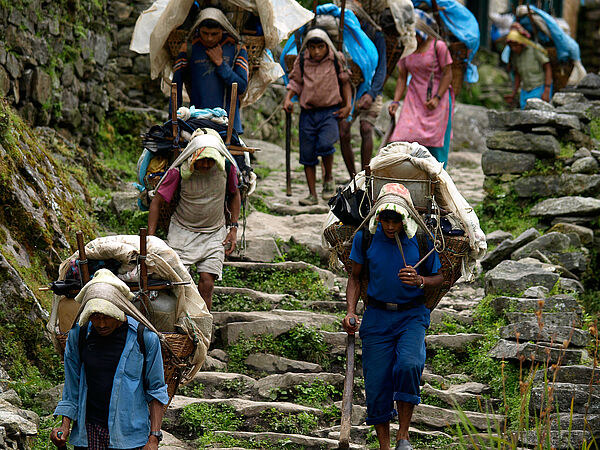
    Suman Prasad Parajuli, President of the Union of Trekking, Travel, Rafting, Airlines, Culture, Archaeologies, Courier and Cargo Workers (UNITRAV), is sounding the alarm bell: “There are altogether around one hundred thousand people working in the trekking sector, who are expected to lose their jobs. Around 70.000 trekking porters, 22.000 licensed trekking guides and 4.000 mountain trekking guides as well as many cooks and cleaners are going to be unemployed. So are five thousand tour guides, 3500 local guides, ten thousand in transport, rafting guides and outsourced airline jobs.”

    After international travel came to a grinding halt in the last weeks, there are still thousands of tourists in the country. Some governments have started to bring their stranded citizens home. Some of them are still stuck in famous tourist destinations like the lakeside city of Pokhara, located close to the Annapurna range, one of the most popular regions for trekking.

    As the last tourists are leaving, their guides and porters stay behind: “Nepal is one of the most famous and safe destinations for mountain and mountaineering activities such as trekking and hiking. There are also many other cultural sights to see, but the European and Asian travelers mostly come for trekking. There are more than one thousand trekking guides and porters who are jobless now in Pokhara due to the lockdown”, says Bijay KC, President of UNITRAV Pokhara.

    Most of them have little protection and often very limited savings: “They work on daily wages: you earn, you eat”, says Dipesh Prasad Thapaliya, tour guide and secretary at the organization department of UNITRAV.

    Workers need support to sustain their livelihoods

    As the country is under lockdown, people are only allowed to go out for grocery shopping. The country’s middle class -mostly living in their family-owned houses – can probably cope with these challenges for a while. Most of them have been stocking up and preparing for a shutdown in the last weeks. Many Nepalis still remember the earthquakes of 2015 and the following hardships all too well. But for daily wage labourers, the times are already harsh. How long can they hold out with little to no savings and without meaningful government support? What are the consequences?

    Dipesh Prasad Thapaliya fears the worst: “There are thousands of workers across the country who run their life through daily wages. It is hard for them to survive, especially in the city areas where they are now stranded because of the lockdown. They are not even able to return to their villages. This economic crisis might bring physical as well as mental problems for them, which might be even more dangerous than the coronavirus.”

    The overall impact on the Nepalese economy is hard to predict, but some immediate effects of the crisis are already felt. Vegetable prices doubled in the last week, the prices of other essential food items went up by 10-20 percent. Propane gas is hard to come by.

    Nepal is heavily reliant on imported goods, most of them coming from India. Nepal’s huge trade deficit has been largely financed with workers’ remittances from abroad, which amount to about 30 percent of the gross domestic product.

    The tourism sector might not recover anytime soon. Meanwhile, people’s livelihoods need to be sustained. But for the workers in the Nepali tourism industry, there is no quick fix in sight.

    Jonathan Menge is the Director of the FES Office in Nepal and coordinates the work on gender justice in Asia. Samira Paudel is a Project Coordinator at FES Nepal.

    Photo: Flickr / Gavin Yeates

    • Connecting you with the world of travel and tourism

      Media Partners

      Asia Amusement & Attractions Expo 2026

      Theme Park Expo Vietnam 2025

      Asia Pool & Spa Expo , May 10 – 12, 2025 , Guangzhou , China

      KAZAKHSTAN International Exhibition “Tourism & Travel” Almaty, Kazakhstan

      Nihao China- Beyond your imagination

      China extends visa-free

      policy to UK, Canada

      China has decided to extend its visa waiver policy to ordinary passport holders from Canada and the United Kingdom starting Tuesday, when the Chinese New Year begins, a Foreign Ministry spokesperson announced on , saying the move aims to further facilitate cross-border travel.

      According to the spokesperson, ordinary passport holders from the two countries can enter China without visa and stay for up to 30 days for business, tourism, family/friends visit, exchange and transit purposes.The policy will be effective until Dec 31.

      Air India Orders 30

      Boeing 737 MAX Jets

      Air India  has ordered 30 more fuel-efficient 737 MAX jets, expanding its Boeing order book to nearly 200 airplanes across the company’s single-aisle and widebody airplane families. Boeing and Air India  announced an order for 30 fuel-efficient 737 MAX jets at the annual Wings Airshow in Hyderabad.

      The airline finalized an incremental purchase of 20 737-8 jets this month and an order for 10 737-10 airplanes was previously unidentified on Boeing’s Orders & Deliveries website. Both purchases exercised existing options as Air India expands its route network to meet rising travel demand.

      Air India will operate the new 737-8s, leveraging their dispatch reliability, fuel efficiency and range flexibility on high-frequency, domestic and short-haul regional routes. The airline also plans to deploy the larger 737-10 to maintain operational commonality and carry more passengers at the lowest cost per seat among single-aisle aircraft.

      As Air India expands its fleet and network, Boeing’s Commercial Market Outlook forecasts the Indian and South Asian region will need nearly 3,300 new airplanes over the next two decades with 90% of those single-aisle jets like the 737 MAX. ( February 2 , 2026 )

      WTTC chooses  Madrid

      for new Global Office

      London, UK: The World Travel & Tourism Council (WTTC) announced that its Operating Committee has unanimously approved Madrid in Spain as the location for the organisation’s new Global Office.

      Five destinations expressed interest in hosting the Global Office – Dubai (UAE), France, Italy, Spain and Switzerland – with the evaluation criteria based on six areas: office rental and operating costs; the tax, incentives and competitive environment; fast-track visas and work permit frameworks in the destination; government support; cost of living to attract and retain talent; and proximity to international organisations.

      The decision to choose Madrid was endorsed by all 17 members of WTTC’s Operating Committee, following a comprehensive assessment of WTTC’s long-term strategic and operational needs. Members agreed that Madrid offered the most attractive option due to the city’s competitiveness, a more favourable tax environment, government support, easier visa processing for employees and overall lower operating costs. Challenges linked to Brexit, such as constraints on talent mobility, made the UK less attractive as WTTC wishes to further build its leadership position and become even more agile in the sector.

      Madrid was also selected for its strong international connectivity via Madrid-Barajas Airport, competitive business environment, incentives from government, synergies with international organisations in the sector such as UN Tourism and alignment with WTTC’s global mission. The new office will form a central part of WTTC’s worldwide network, supporting its highly-respected advocacy, research and member engagement activities across the globe.

      Bangkok named Asia’s best

      holiday destination for 2025

      Bangkok has been ranked as the best city to visit in Asia for 2025 by Smart Travel Asia, a leading digital travel magazine, based on the opinions of hundreds of thousands of travellers and readers worldwide.

      The city received the highest votes in the “Best Holiday Destination in Asia” category, retaining its top position for the second consecutive year.

      Smart Travel Asia highlighted Bangkok’s strengths as its 24-hour vibrancy and diverse experiences, including food, culture, shopping, and the friendliness of its people, describing it as a “city full of energy and colour, day and night.”

      The city’s dominance stems from several compelling factors. Bangkok has emerged as a paradise for food enthusiasts, offering everything from legendary street food stalls to Michelin-starred restaurants and panoramic 360-degree rooftop bars. Its cultural and heritage sites, including the iconic Wat Phra Kaew, Wat Arun, and Wat Pho temples, remain major attractions to international tourists.

      Additionally, from luxury malls in the city centre to the Chatuchak weekend market, Bangkok caters to every type of shopper. Affordability and friendliness also play a key role, as Bangkok remains an accessible living cost destination where welcoming smiles continue to charm travellers.

      In the Smart Travel Asia 2025 rankings, Bali (Indonesia) and Tokyo (Japan) shared second place behind Bangkok, while Seoul (the Republic of Korea) and Luang Prabang (Laos) tied for fourth. Thailand further strengthened its tourism appeal with Chiang Mai placing third and Phuket sharing fifth place with Hong Kong (China).

      Having the three cities, Bangkok, Chiang Mai, and Phuket, in the top 10 highlights the diversity and appeal of Thailand’s tourism offerings for travellers worldwide. — VNA/VNS ( Oct.12, 2025)

      Gulf Cooperation Council Tourism 

      Dubai – As tourism destinations in the Gulf Cooperation Council (GCC) continue to grow, involving local communities in destination development has become increasingly vital for long-term success.

      Abu Dhabi’s Tourism Strategy 2030 aims for 39.3 million visitors per year, while Saudi Arabia’s Vision 2030 targets 150 million domestic and international visits, emphasising how tourism is being established as a key element of economic diversification throughout the region.

      At Arabian Travel Market (ATM) 2025, industry leaders emphasised that sustainable revitalisation of destinations must align tourism investments with community partnerships, cultural authenticity, and immersive guest experiences to provide lasting value for both residents and visitors.

      During the session on “Considerations and Implications of Involving Communities in Destination Revitalisation” on the ATM 2025 Global Stage, experts shared insights into building resilience, enhancing local prosperity, and ensuring tourism growth is both inclusive and enduring.

      Arabian Travel Market 2025, held under the theme “Global Travel: Developing Tomorrow’s Tourism Through Enhanced Connectivity”,  featured more than 200 speakers across three content stages and welcomes over 55,000 travel professionals from 166 countries.

      Messe Berlin India launched 

      to drive growth of ITB India 

      Messe Berlin announces the official launch of Messe Berlin India, a newly incorporated subsidiary that underscores the company’s long-term commitment to one of Asia’s fastest-growing markets. Headquartered in Delhi , the new entity will serve as a strategic base for expanding ITB India and launching future projects tailored to the Indian market. With this establishment, Messe Berlin is reinforcing its vision of India as a regional hub for innovation, collaboration, and sustainable business growth within the exhibition and events industry.

      “Messe Berlin’s presence in India reflects our strategic intent to strengthen our international reach by being where the growth is. India is a key market for us — vibrant, diverse, and full of opportunities. With Messe Berlin India, we are laying down long-term foundations to build strong partnerships, support local industries, and elevate our global platforms,” said Dr. Mario Tobias, CEO, Messe Berlin.

      ITB India, inaugurated in 2023, continues as the flagship event under the new subsidiary. Held annually, ITB India is a three-day B2B travel trade show and convention that connects the global travel and tourism industry with the Indian market. Alongside MICE Show India, Travel Tech India, and the ITB India Conference, ITB India serves as a unique platform to forge new partnerships, strengthen existing ties, and capitalize on the fast-growing potential of the Indian and South Asian travel economies. The show hosts key players from the MICE, Leisure, Corporate Travel, and Travel Technology sectors. The upcoming edition, ITB India 2025, will take place from 2 – 4 September 2025  in Mumbai.

      FACTS —

      Tourism helps in:

      👉Reducing poverty

      👉Reducing Inequalities

      👉Promoting gender equality

      👉Fostering decent work and economic growth

      World Tourism Day 2021: ‘Tourism for Inclusive Growth’

      In 2019, Travel & Tourism’s direct, indirect and induced impact accounted for:
      -US$8.9 trillion contribution to the world’s GDP
      -10.3% of global GDP
      -330 million jobs, 1 in 10 jobs around the world
      -US$1.7 trillion visitor exports (6.8% of total exports,
      28.3% of global services exports)
      -US$948 billion capital investment (4.3% of total
      investment)

      Tibet Travel : Daily Life of Living under Mount Everest