• Protect Elephants and Gorillas to sustain our forests
    March 20, 2014
    Protect Elephants and Gorillas to sustain our forests

    By Bradnee Chambers  ————————

    BONN (IPS) – Of the endangered species listed for protection under the Convention on Migratory Species (CMS) a great many are forest dwellers – West African elephants, gorillas, bats and many birds.

    And it is not simply a case of the animals depending on the forest for food and suitable habitat to breed and raise their young — the forest often depends on the animals too.

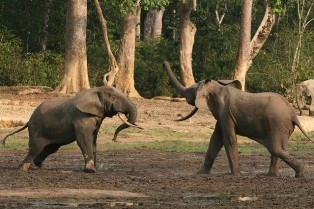
    Conservationist and CMS ambassador Ian Redmond describes elephants and gorillas as “gardeners of the forest”. Elephants provide an invaluable service by uprooting trees, thereby making holes on the jungle canopy which allows light to reach plants closer to the ground and encourages their growth.

    Forest ecosystems, the most biodiverse of all terrestrial habitats, are often very finely balanced.
    Gorillas eat fruit and the seeds pass through their digestive tract to be deposited as fertiliser. Tropical fruit bats also play an important role in the pollination of plants.

    Forest ecosystems, the most biodiverse of all terrestrial habitats, are often very finely balanced. The more diverse, the more robust they are and the better they are at doing what we want – and need them – to do.

    While usually many species perform the same function, the removal of a top predator, pollinator or seed disperser can set off a chain reaction, with far-reaching consequences.

    A reduction in the forest’s resilience, increasing the likelihood of further species loss, can impinge on its ability to provide the ecosystem services, such as water purification and the production of oxygen upon which human well-being depends. The livelihoods of as much as a fifth of the world’s population are directly linked to forests, which also provide a home for 300 million people.

    The presence (or absence) of an animal as significant as elephants can have huge effects on the character of the habitat, as has been demonstrated by comparing two similar forest landscapes in Uganda.

    Douglas Sheil and Agus Salim Center for International Forestry Research, Jakarta, Indonesia found in 2004 that the patterns of succession and regeneration in Budungo forest, which has no elephants, are totally different from those in Rabongo forest. Both forests are in Uganda where there exists a large elephant population.

    It has been estimated that approaching one sixth of all greenhouse gas emissions can be attributed to deforestation and forest degradation.

    A similar proportion of human-generated carbon dioxide can be removed from the atmosphere by forests acting as “carbon sinks” through sequestration. Tropical forests also help to cool the planet as large quantities of water evaporate forming clouds that reflect sunlight away from the surface.

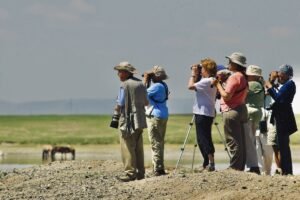
    Eco-tourism is a booming business worth billions of dollars a year and wildlife watching forms a significant part of the sector. Sensitively managed, all players reap the benefits – the tourist gets the “close to nature” experience, employment opportunities are created in the local economy and the animals are seen as a valuable asset, not as an irrelevance, nuisance or a threat and therefore worth protecting.

    Visitors are prepared to pay fees of 750 dollars to see the mountain gorillas of the Virunga National Park in Rwanda, where 10 groups of the reclusive animals have now been habituated to human visits. The visits are conducted under strict conditions: no more than eight tourists at any time; no noise; no approaching the animals; no litter; and, given the gorillas’ susceptibility to human diseases, no participants who are visibly ill.

    During the 1990s the mountain gorilla numbers rose by 17 percent, with the greatest increase amongst those groups habituated to tourists and researchers. Without gorilla watching and the associated conservation efforts it is probable that the mountain gorilla subspecies would not have survived.

    Instead it is estimated that today there might now be as many as 1,000 Mountain gorillas – still too few for the International Union for Conservation of Nature to regard them as anything more secure than critically endangered. The outlook is less rosy for the more numerous lowland gorilla subspecies, which are seeing their habitat destroyed by logging and conversion to agriculture and which are hunted for bushmeat, with some of the traumatised, orphaned young ending up in the exotic pet trade.

    The baby animals certainly look appealing and generally gorillas are characterised by their gentle demeanour, but they do not stay young and cute for long. They are totally unsuited for domestication with a two-metre adult male weighing in at over 200 kgs.

    Many endangered migratory species cannot do without forests; and the forests need the migratory species.

    Humans need both as they contribute to a healthy environment, a benign climate, a sustainable economy and to a shared natural heritage that enriches our live in ways that cannot be expressed in monetary terms. 

    March 20, 2014

    • Connecting you with the world of travel and tourism

      Media Partners

      Asia Amusement & Attractions Expo 2026

      Theme Park Expo Vietnam 2025

      Asia Pool & Spa Expo , May 10 – 12, 2025 , Guangzhou , China

      KAZAKHSTAN International Exhibition “Tourism & Travel” Almaty, Kazakhstan

      Nihao China- Beyond your imagination

      Zhejiang Province , China

      Bangkok named Asia’s best

      holiday destination for 2025

      Bangkok has been ranked as the best city to visit in Asia for 2025 by Smart Travel Asia, a leading digital travel magazine, based on the opinions of hundreds of thousands of travellers and readers worldwide.

      The city received the highest votes in the “Best Holiday Destination in Asia” category, retaining its top position for the second consecutive year.

      Smart Travel Asia highlighted Bangkok’s strengths as its 24-hour vibrancy and diverse experiences, including food, culture, shopping, and the friendliness of its people, describing it as a “city full of energy and colour, day and night.”

      The city’s dominance stems from several compelling factors. Bangkok has emerged as a paradise for food enthusiasts, offering everything from legendary street food stalls to Michelin-starred restaurants and panoramic 360-degree rooftop bars. Its cultural and heritage sites, including the iconic Wat Phra Kaew, Wat Arun, and Wat Pho temples, remain major attractions to international tourists.

      Additionally, from luxury malls in the city centre to the Chatuchak weekend market, Bangkok caters to every type of shopper. Affordability and friendliness also play a key role, as Bangkok remains an accessible living cost destination where welcoming smiles continue to charm travellers.

      In the Smart Travel Asia 2025 rankings, Bali (Indonesia) and Tokyo (Japan) shared second place behind Bangkok, while Seoul (the Republic of Korea) and Luang Prabang (Laos) tied for fourth. Thailand further strengthened its tourism appeal with Chiang Mai placing third and Phuket sharing fifth place with Hong Kong (China).

      Having the three cities, Bangkok, Chiang Mai, and Phuket, in the top 10 highlights the diversity and appeal of Thailand’s tourism offerings for travellers worldwide. — VNA/VNS ( Oct.12, 2025)

      India resumes tourist visa for

      Chinese citizens after 5 years

      India announced  that it will open tourist visa applications to Chinese citizens from July 24, 2025. It was the first time in five years since the South Asian country suspended Chinese citizens’ tourist visa applications in February 2020.

      The Embassy of India in China announced via its Sina Weibo account  that, starting from July 24, 2025, Chinese citizens can apply for a tourist visa to visit India after completing an online application, scheduling an appointment, and personally submitting their passport and other required documents to three Indian visa application centers in Beijing, Shanghai, and Guangzhou in South China’s Guangdong Province.

      Responding to the related inquiry, Chinese Foreign Ministry spokesperson Guo Jiakun said  that “we take note of this positive move. Easing cross-border travel is widely beneficial. China will maintain communication and consultation with India to further facilitate travel between the two countries.”

      Chinese experts said the latest move taken by the India marks a phased milestone in the easing of relations between the two countries, and creates favorable conditions for further strengthening bilateral people-to-people exchanges.

      On February 2, 2020, India temporarily suspended its e-visa facility for Chinese travelers and foreigners residing in China amid coronavirus outbreak. – Global Times

      Gulf Cooperation Council Tourism 

      Dubai – As tourism destinations in the Gulf Cooperation Council (GCC) continue to grow, involving local communities in destination development has become increasingly vital for long-term success.

      Abu Dhabi’s Tourism Strategy 2030 aims for 39.3 million visitors per year, while Saudi Arabia’s Vision 2030 targets 150 million domestic and international visits, emphasising how tourism is being established as a key element of economic diversification throughout the region.

      At Arabian Travel Market (ATM) 2025, industry leaders emphasised that sustainable revitalisation of destinations must align tourism investments with community partnerships, cultural authenticity, and immersive guest experiences to provide lasting value for both residents and visitors.

      During the session on “Considerations and Implications of Involving Communities in Destination Revitalisation” on the ATM 2025 Global Stage, experts shared insights into building resilience, enhancing local prosperity, and ensuring tourism growth is both inclusive and enduring.

      Arabian Travel Market 2025, held under the theme “Global Travel: Developing Tomorrow’s Tourism Through Enhanced Connectivity”,  featured more than 200 speakers across three content stages and welcomes over 55,000 travel professionals from 166 countries.

      Messe Berlin India launched 

      to drive growth of ITB India 

      Messe Berlin announces the official launch of Messe Berlin India, a newly incorporated subsidiary that underscores the company’s long-term commitment to one of Asia’s fastest-growing markets. Headquartered in Delhi , the new entity will serve as a strategic base for expanding ITB India and launching future projects tailored to the Indian market. With this establishment, Messe Berlin is reinforcing its vision of India as a regional hub for innovation, collaboration, and sustainable business growth within the exhibition and events industry.

      “Messe Berlin’s presence in India reflects our strategic intent to strengthen our international reach by being where the growth is. India is a key market for us — vibrant, diverse, and full of opportunities. With Messe Berlin India, we are laying down long-term foundations to build strong partnerships, support local industries, and elevate our global platforms,” said Dr. Mario Tobias, CEO, Messe Berlin.

      ITB India, inaugurated in 2023, continues as the flagship event under the new subsidiary. Held annually, ITB India is a three-day B2B travel trade show and convention that connects the global travel and tourism industry with the Indian market. Alongside MICE Show India, Travel Tech India, and the ITB India Conference, ITB India serves as a unique platform to forge new partnerships, strengthen existing ties, and capitalize on the fast-growing potential of the Indian and South Asian travel economies. The show hosts key players from the MICE, Leisure, Corporate Travel, and Travel Technology sectors. The upcoming edition, ITB India 2025, will take place from 2 – 4 September 2025  in Mumbai.

      FACTS —

      Tourism helps in:

      👉Reducing poverty

      👉Reducing Inequalities

      👉Promoting gender equality

      👉Fostering decent work and economic growth

      World Tourism Day 2021: ‘Tourism for Inclusive Growth’

      In 2019, Travel & Tourism’s direct, indirect and induced impact accounted for:
      -US$8.9 trillion contribution to the world’s GDP
      -10.3% of global GDP
      -330 million jobs, 1 in 10 jobs around the world
      -US$1.7 trillion visitor exports (6.8% of total exports,
      28.3% of global services exports)
      -US$948 billion capital investment (4.3% of total
      investment)

      Tibet Travel : Daily Life of Living under Mount Everest