The Mustang region of Nepal
– Gilles Sabrie for The New York Times
Centuries ago, it destroyed the foundations of a Buddhist monastery under construction in central Tibet. Then Guru Rinpoche, who had brought Buddhism to the kingdom, pursued the demon west, deep into Mustang. The two fought among Mustang’s snow peaks, desert canyons and grasslands. Guru Rinpoche prevailed, and he scattered the demon’s body parts across Mustang: its blood formed towering red cliffs, and its intestines tumbled to the wind-scoured earth east of the cliffs. Later, people would build a wall of prayer stones, the longest in Nepal, atop the intestines.
On the fifth day of our trek, we stood above the demon’s heart. Here, on a hillside, the people of Mustang had built the monastery of Lo Gekar, one of the oldest in the Tibetan world. A lama showed us around. I found no remnants of a demonic heart, but the walls in a dark room at the rear were covered with paintings of fearsome creatures with fangs and blue skin. Tibetans called them protector deities. Our guide, Karma, pulled me over into the shadows and pointed to another wall. I squinted, and saw a statue of Buddha that had been carved from the rock. Or so I thought.
“They say the statue is natural and was discovered this way,” Karma said. “People in Mustang have many stories. They believe everything. There are spirits everywhere you look.”
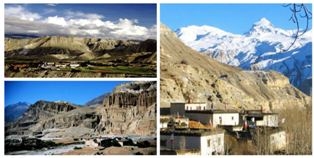
Mustang was a caldron of myth, as I discovered on a 16-day trek through the Himalayan region of Nepal in September. Modernity was creeping in to the area, but the stories that people told had evolved little over centuries. As I walked through the valleys and white-walled villages, I heard tales that brought alive the harsh land, a place of deep ravines and stinging wind and ancient cave homes. It had been this way before the kingdom was united under Ame Pal in the 14th century, and the narratives seem as alive today as ever.
I had longed to visit Mustang ever since I got a glimpse of it while trekking the nearby Annapurna Circuit 12 years ago. On the northern arc of the circuit was the village of Kagbeni, with its red-walled monastery. To the north was an expansive gorge carved by the Kali Gandaki River. Beyond lay Upper Mustang, or the Kingdom of Lo, forbidden to those who did not have a permit from the Nepalese government.
This fall seemed like the right time for me to go. As a boy, I had seen my mother embrace certain Buddhist beliefs, and later I began walking paths in the Himalayas in search of something transcendent in the landscape and the abiding expressions of faith. I would soon turn 40, and my first child was on the way. It was time to make a Himalayan pilgrimage at the close of a chapter of my life and the beginning of another.
There was another reason to visit now. Last year, as a wave of self-immolations swept across the Tibetan plateau, China restricted access to the region — which had already been limited since 2008. For tourists, Mustang is a good alternative. It provides a taste of authentic Tibetan culture, and, like much of Tibet, it lies in the Trans-Himalaya, a vast high-altitude desert to the north of the main Himalayan range, which blocks most of the monsoon clouds that dump rain on India and Southeast Asia in the summer.
Last year, nearly 3,000 tourists entered Upper Mustang, according to statistics in a government office in Kagbeni, an increase of more than 25 percent from about three years earlier. But the permit fee — $500 for 10 days, and $10 for each additional day — still deters many travelers. The low numbers, though, are welcomed by those trekkers looking to avoid the busy Annapurna and Everest trails, as well as by some Mustangis, even ones who say the government needs to give Mustang a greater portion of permit revenue.
“Our land is in one of the most beautiful corners of the world,” said Jigme Singi Palbar Bista, 55, the ceremonial prince of Mustang. “But if a lot of tourists come, we wouldn’t be able to support them all.”
After a week in the Katmandu Valley with my wife, Tini, I met up with my friend Gilles and flew north, between the Annapurna and Dhaulagiri massifs. Many trekkers rush from Kagbeni to Lo Manthang, the walled capital of Mustang, and back in 10 days. We decided to go more slowly and explore some of the hidden corners along the way. Summertime in Nepal is when some of its last remaining nomads set up camp in the high grasslands west of Lo Manthang. In that area, too, are peaks of more than 20,000 feet beckoning to be explored. A 16-day permit would also allow us time to travel up the valleys running north of Lo Manthang, toward Tibet, and then return to Kagbeni along the canyons east of the Kali Gandaki. The eastern half of Mustang was more remote, and it had some of the best-preserved Tibetan Buddhist cave art in the world.
Each day of the trek, I marveled at how the landscape of Mustang was unlike anything I had seen in the Himalayas. It was a place of canyon vistas revolving around the enormous valley of the Kali Gandaki. The trekking routes on both sides of the river ran up and down side valleys. The rivers were low most of the year, but some summer monsoon rains meant we had to ford rivers a half-dozen times.
Much of Upper Mustang is a desolate place, inhabited by about 5,400 people and once crossed only by Tibetan pilgrims and yak caravans. We entered the area on the second day of the trek. There, at a wide stretch of the Kali Gandaki, the waters were flowing high and fast. All our gear was lashed to three horses. Besides Karma, our team consisted of Gombo, a horseman from Lo Manthang, and Fhinju, an ethnic Sherpa cook.
After the trail crossed the Kali Gandaki, it climbed steeply up to the village of Samar, considered the wettest and greenest place in Mustang. Right before dusk, we crossed a pass draped with Tibetan prayer flags and walked down to a lodge. Karma came from Samar, and his brother, the village head, owned the lodge. The main villages in Mustang all had at least one home where trekkers could stay. The rooms had simple beds or a bench with a thick Tibetan wool rug. Exhausted from a long day of trekking, Gilles and I sat down in the warm kitchen for dinner, next to French travelers. For dessert, the brother’s wife prepared apple pie with custard.
From next door came the sound of a pounding drum. “Traveling lamas,” Karma said.
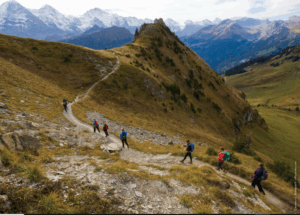
Over the next days, we settled into our trekking routine: get up at 6 or 7, eat breakfast, walk for six to eight hours, reach a village before nightfall. The countryside became more barren the farther north we went, as we approached Lo Manthang. The hues of the mountains — shades of red and brown and ocher — changed each day, and varied with the movement of the sun.
All across the rugged land, people had built Buddhist chortens, or small stupas, atop hills, on pathways leading into villages and even inside caves, in part to ward off spirits that would do them harm. Tibetan Buddhism and the myths were intertwined threads that were in turn woven into the landscape.
With the tail end of the monsoon came the harvest. Villagers were out in the fields cutting down golden stalks of barley. But the harvest also brought out more stories of curses, bad spirits and misfortunes that could befall people. Karma said the high passes that linked Mustang with the arid land of Dolpo to the west could not be crossed until after the harvest, legend had it, lest the harvest end in disaster. The same held for climbing the unnamed peaks that rose to over 20,000 feet west of Lo Manthang. One day, tempting fate, I walked up one. When I reached the snowline, above 19,400 feet, it began hailing. Dark clouds loomed. I went down.
We reached Lo Manthang after that climb and a couple of nights camping near nomad families. We had sat in their black yak-wool tents and sipped cups of buttermilk tea. In Lo Manthang, I spoke to the prince of Mustang (his father, the 80-year-old king, had been ill for weeks) and visited the three red-walled monasteries at the heart of the town. We met a team of dozens of locals being led by an Italian, Luigi Fieni, who was repainting Buddhist artwork in the gargantuan Thubchen Monastery. Its towering roof was held up by a forest of wood pillars and its enormous gilded statues inspired awe.
After two days, we left, following Karma to a place just as singular but hidden by the land. From the village of Yara, we approached a cave east of the Kali Gandaki gorge that was reachable only by a vertical climb. We took off our packs and scrambled up using our hands. One slip and we would have plummeted hundreds of feet to the valley floor.
This was Tashi Kabum, a cave temple that local villagers had opened to the public only a few years ago. Inside was a large white chorten, and painted on the cave walls and roof were some of the best preserved ancient Buddhist art I had ever seen. I could make out lotus petals on the roof. On one wall was a portrait of a lama in red robes. More enigmatic was a painting of a smiling, ivory-skinned man in a seated position. His face was illuminated by sunlight streaming through an opening in the cliffside.
Fhinju, our Sherpa companion, brushed his fingers over the painting. “Chenrezig,” he said, and bowed his head in prayer.
For Tibetan Buddhists, Chenrezig was a bodhisattva embodying compassion. Tibetans believed the Dalai Lama was a reincarnation of him. He was a central figure in Buddhist pantheons across Asia. Growing up in an American suburb, I had watched my mother pray nightly in our living room to a statue of the Chinese incarnation, Guanyin.
Here, as far from my childhood home as it was possible to be, he gazed out at me again. Faith in him had crossed borders and transcended time. The tale took on a different meaning with each person. I stared into his eyes and saw his story unfolding in days to come.
Most trekkers enter Upper Mustang at the village of Kagbeni. The nearest airport is at Jomsom, a three-hour walk away. Flights to Jomsom from the resort town of Pokhara cost less than $100 each way. The airlines and frequency vary with the season, and there are often cancellations due to bad weather. But the view from the plane, which passes between some of the world’s highest mountains, is jaw-dropping. One alternative is to take a 14-hour bus ride to Jomsom along a route that has frequent landslides. Courtesy : International Heral Tribune