• Climbers have turned Mount Everest into a high-altitude garbage dump, but sustainable solutions are within reach
    Climbers have turned Mount Everest into a high-altitude garbage dump, but sustainable solutions are within reach

    Suzanne OConnell / Alton C. Byers

    Spring is go time for climbers who hope to summit Mount Everest, Earth’s highest peak above sea level. Hundreds of mountaineers from around the world travel to Asia in April and May, headed for base camps in Nepal and Tibet.

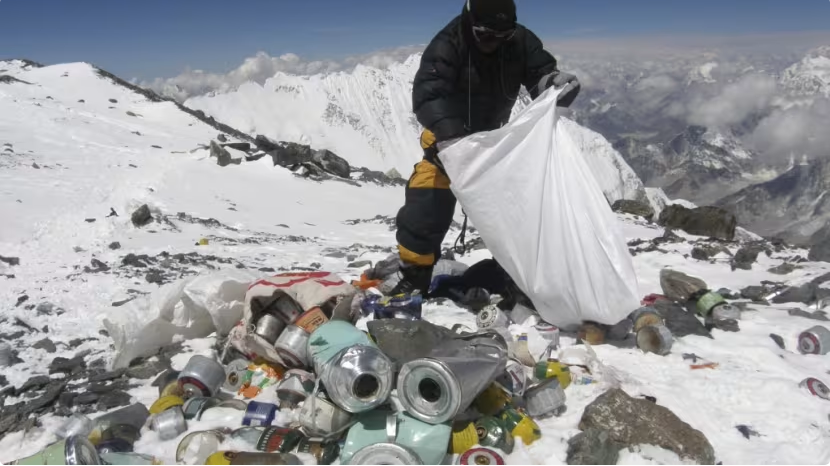
    But jagged peaks won’t be the only thing they see. Especially on Everest’s more heavily traversed Nepal side, they’ll find fields of garbage – including cans, bottles, plastic and human and animal excrement.

    Each year, more than 60,000 trekkers and climbers visit the Sagarmatha National Park and Buffer Zone, a high-altitude swath of the Khumbu region in northeast Nepal that includes Everest and seven other peaks. Some 400 to 500 climbers attempt to summit Everest every year.

    The trash problem first became evident in the 1980s and 1990s, when climbing on the mountain and trekking in Khumbu began to increase. Climber and trekker numbers have further skyrocketed in the past 20 years.

    Most coverage of this issue focuses on negative and sensational aspects, such as the frozen bodies of climbers who remain where they died on the mountain because removal operations are risky and expensive.

    We are scholars who study geoscience and mountain geography, and one of us (Alton Byers) has lived in Nepal and worked with communities around Everest. We are encouraged to see increased efforts to address Everest’s massive trash problem. In our view, modern technology and international cooperation are key to ending the pileup of waste in this iconic setting.

    Pollution from waste

    For most visitors to this area of the Himalayas, Everest base camp on the upper reaches of the rapidly receding Khumbu Glacier is the ultimate destination, at an altitude of 17,589 feet (5,364 meters). Formerly a two- to three-week trek from Kathmandu, today the journey is most likely to begin at the Lukla Airport, which sits about 35 miles (60 kilometers) from base camp.

    Climbers who aim to summit Everest typically spend up to two months on the mountain, including weeks making short, incremental ascents above base camp and back down again. This enables them to acclimate to the altitude before climbing to higher camps and then to the summit.

    Much of the food and equipment headed to Everest also begins its journey at Lukla. Some is shipped to base camp by helicopter, but much of the gear is carried there by yaks, yak/cattle crossbreeds called dzopkio, mules and horses.

    Lots of equipment, food and packaging, plus animals and porters, means a lot of garbage. A 2010 study estimated that park tourism generated 4.6 tons of solid waste per day during peak tourist periods in April-May and October-November.

    Eventually most of this refuse is dumped into unsightly landfills a short distance from local villages. There it is burned, adding particulates and toxic chemicals to the air. The remaining ash is buried, where it can contaminate groundwater.

    At the base camp, microplastics – likely from discarded mountaineering clothing, tents, ropes and boots – have been found in water and snow samples. High levels of perfluoroalkyl and polyfluoroalkyl substances, or PFAS, widely known as “forever chemicals,” have been found on the Khumbu glacier, probably from materials used to waterproof climbing boots, tents and clothing.

    These substances could pose health risks for transient climbers, but are a more serious threat for people who live in the nearby settlements of Gorak Shep, Lobuche, Dugla and Pheriche for most of the year. Some of these villagers work at Everest base camp and are exposed there too.

    And then there’s sewage. Most septic tanks at the hundreds of lodges located throughout the national park and buffer zone leak, further polluting groundwater. Camp Four, the last site that climbers occupy before they attempt to summit Everest, is covered with garbage and frozen, wind-swept feces.

    National parks in developed countries have infrastructure to handle waste management, trash pickup, recycling and wastewater treatment. At Everest base camp, there are just collection barrels under toilets. Each year, some 50,000 pounds (22,000 kilograms) of human waste are brought to landfills several kilometers away.

    Solutions for sustainable tourism

    Recognizing the scale of this problem, initiatives are in progress to develop solutions.

    The Sagarmatha Pollution Control Committee, created by local Sherpa people in 1991, is an Indigenous nonprofit organization that is responsible for monitoring garbage in the permit-required mountains and peaks. The group focuses on litter control and periodic base camp cleanups.

    In 2014, the government of Nepal began requiring every mountaineer who climbs above the Everest base camp to bring back 18 pounds (8 kilograms) of solid waste from the mountain or forfeit a US$4,000 deposit. Of course, if you’ve paid $75,000 or more for the trip, losing the deposit may not be much of an incentive. Many people elect to forfeit it.

    A nonprofit called Sagarmatha Next, established in 2019, is working to promote sustainable tourism in the Khumbu region, partnering with companies and organizations from around the world. The group has raised awareness by producing art works and souvenirs from trash. It also launched a “Carry Me Back” program that encourages tourists to take two-pound (one-kilogram) bags of solid waste, such as shredded plastic bottles, to the airstrip at Lukla for processing and disposal in Kathmandu.

    At the local government’s request, the University of Colorado Boulder developed a sustainable solid waste management plan in 2019 for the national park and buffer zone. The COVID-19 pandemic delayed implementation of the plan, which proposes creating a five-step process: waste segregation, collection, sorting and shredding, transfer to shipment stations and transportation to recycling facilities in Kathmandu.

    Another nonprofit initiative, the NeverRest Project, was created during the pandemic to provide environmental solutions for Mount Everest and other fragile ecosystems around the world. NeverRest is working with the Nepal Tourism Board to revolutionize high-altitude waste management using modern technology.

    In 2023, the organization presented a concept plan for a sustainable Everest base camp that would install technologies such as portable solar tents to reduce use of fossil fuel; unisex portable urinals with multi-use filters that convert urine into water; incinerator toilets that transform human waste into ash; and modular geodesic dome tents designed for effective heat retention to reduce energy use.

    In the 71 years since Sir Edmund Hillary and Sherpa Tenzing Norgay made the first known successful ascent of Mount Everest, this peak has been a setting for daring expeditions, triumphs and tragedies. We hope that the region’s garbage problem soon will fade into history as new approaches and technologies provide solutions for Everest and other remote high-mountain locations around the world. ( Source :The CONVERSATION )

    May 6 2024

    Suzanne OConnell is Harold T Stearns Professor of Earth Science at Wesleyan University. Alton C Byers is Senior Research Associate at the Institute of Arctic and Alpine Research, University of Colorado Boulder. This commentary first appeared on The Conversation.

    Photo : Picture taken on May 23, 2010 shows a Nepalese Sherpa collecting garbage, left by climbers, at an altitude of 8,000m at Mount Everest. (Photo: AFP/Namgyal SHERPA)


    • Connecting you with the world of travel and tourism

      Media Partners

      Asia Amusement & Attractions Expo 2026

      Theme Park Expo Vietnam 2025

      Asia Pool & Spa Expo , May 10 – 12, 2025 , Guangzhou , China

      KAZAKHSTAN International Exhibition “Tourism & Travel” Almaty, Kazakhstan

      Nihao China- Beyond your imagination

      China extends visa-free

      policy to UK, Canada

      China has decided to extend its visa waiver policy to ordinary passport holders from Canada and the United Kingdom starting Tuesday, when the Chinese New Year begins, a Foreign Ministry spokesperson announced on , saying the move aims to further facilitate cross-border travel.

      According to the spokesperson, ordinary passport holders from the two countries can enter China without visa and stay for up to 30 days for business, tourism, family/friends visit, exchange and transit purposes.The policy will be effective until Dec 31.

      Air India Orders 30

      Boeing 737 MAX Jets

      Air India  has ordered 30 more fuel-efficient 737 MAX jets, expanding its Boeing order book to nearly 200 airplanes across the company’s single-aisle and widebody airplane families. Boeing and Air India  announced an order for 30 fuel-efficient 737 MAX jets at the annual Wings Airshow in Hyderabad.

      The airline finalized an incremental purchase of 20 737-8 jets this month and an order for 10 737-10 airplanes was previously unidentified on Boeing’s Orders & Deliveries website. Both purchases exercised existing options as Air India expands its route network to meet rising travel demand.

      Air India will operate the new 737-8s, leveraging their dispatch reliability, fuel efficiency and range flexibility on high-frequency, domestic and short-haul regional routes. The airline also plans to deploy the larger 737-10 to maintain operational commonality and carry more passengers at the lowest cost per seat among single-aisle aircraft.

      As Air India expands its fleet and network, Boeing’s Commercial Market Outlook forecasts the Indian and South Asian region will need nearly 3,300 new airplanes over the next two decades with 90% of those single-aisle jets like the 737 MAX. ( February 2 , 2026 )

      WTTC chooses  Madrid

      for new Global Office

      London, UK: The World Travel & Tourism Council (WTTC) announced that its Operating Committee has unanimously approved Madrid in Spain as the location for the organisation’s new Global Office.

      Five destinations expressed interest in hosting the Global Office – Dubai (UAE), France, Italy, Spain and Switzerland – with the evaluation criteria based on six areas: office rental and operating costs; the tax, incentives and competitive environment; fast-track visas and work permit frameworks in the destination; government support; cost of living to attract and retain talent; and proximity to international organisations.

      The decision to choose Madrid was endorsed by all 17 members of WTTC’s Operating Committee, following a comprehensive assessment of WTTC’s long-term strategic and operational needs. Members agreed that Madrid offered the most attractive option due to the city’s competitiveness, a more favourable tax environment, government support, easier visa processing for employees and overall lower operating costs. Challenges linked to Brexit, such as constraints on talent mobility, made the UK less attractive as WTTC wishes to further build its leadership position and become even more agile in the sector.

      Madrid was also selected for its strong international connectivity via Madrid-Barajas Airport, competitive business environment, incentives from government, synergies with international organisations in the sector such as UN Tourism and alignment with WTTC’s global mission. The new office will form a central part of WTTC’s worldwide network, supporting its highly-respected advocacy, research and member engagement activities across the globe.

      Bangkok named Asia’s best

      holiday destination for 2025

      Bangkok has been ranked as the best city to visit in Asia for 2025 by Smart Travel Asia, a leading digital travel magazine, based on the opinions of hundreds of thousands of travellers and readers worldwide.

      The city received the highest votes in the “Best Holiday Destination in Asia” category, retaining its top position for the second consecutive year.

      Smart Travel Asia highlighted Bangkok’s strengths as its 24-hour vibrancy and diverse experiences, including food, culture, shopping, and the friendliness of its people, describing it as a “city full of energy and colour, day and night.”

      The city’s dominance stems from several compelling factors. Bangkok has emerged as a paradise for food enthusiasts, offering everything from legendary street food stalls to Michelin-starred restaurants and panoramic 360-degree rooftop bars. Its cultural and heritage sites, including the iconic Wat Phra Kaew, Wat Arun, and Wat Pho temples, remain major attractions to international tourists.

      Additionally, from luxury malls in the city centre to the Chatuchak weekend market, Bangkok caters to every type of shopper. Affordability and friendliness also play a key role, as Bangkok remains an accessible living cost destination where welcoming smiles continue to charm travellers.

      In the Smart Travel Asia 2025 rankings, Bali (Indonesia) and Tokyo (Japan) shared second place behind Bangkok, while Seoul (the Republic of Korea) and Luang Prabang (Laos) tied for fourth. Thailand further strengthened its tourism appeal with Chiang Mai placing third and Phuket sharing fifth place with Hong Kong (China).

      Having the three cities, Bangkok, Chiang Mai, and Phuket, in the top 10 highlights the diversity and appeal of Thailand’s tourism offerings for travellers worldwide. — VNA/VNS ( Oct.12, 2025)

      Gulf Cooperation Council Tourism 

      Dubai – As tourism destinations in the Gulf Cooperation Council (GCC) continue to grow, involving local communities in destination development has become increasingly vital for long-term success.

      Abu Dhabi’s Tourism Strategy 2030 aims for 39.3 million visitors per year, while Saudi Arabia’s Vision 2030 targets 150 million domestic and international visits, emphasising how tourism is being established as a key element of economic diversification throughout the region.

      At Arabian Travel Market (ATM) 2025, industry leaders emphasised that sustainable revitalisation of destinations must align tourism investments with community partnerships, cultural authenticity, and immersive guest experiences to provide lasting value for both residents and visitors.

      During the session on “Considerations and Implications of Involving Communities in Destination Revitalisation” on the ATM 2025 Global Stage, experts shared insights into building resilience, enhancing local prosperity, and ensuring tourism growth is both inclusive and enduring.

      Arabian Travel Market 2025, held under the theme “Global Travel: Developing Tomorrow’s Tourism Through Enhanced Connectivity”,  featured more than 200 speakers across three content stages and welcomes over 55,000 travel professionals from 166 countries.

      Messe Berlin India launched 

      to drive growth of ITB India 

      Messe Berlin announces the official launch of Messe Berlin India, a newly incorporated subsidiary that underscores the company’s long-term commitment to one of Asia’s fastest-growing markets. Headquartered in Delhi , the new entity will serve as a strategic base for expanding ITB India and launching future projects tailored to the Indian market. With this establishment, Messe Berlin is reinforcing its vision of India as a regional hub for innovation, collaboration, and sustainable business growth within the exhibition and events industry.

      “Messe Berlin’s presence in India reflects our strategic intent to strengthen our international reach by being where the growth is. India is a key market for us — vibrant, diverse, and full of opportunities. With Messe Berlin India, we are laying down long-term foundations to build strong partnerships, support local industries, and elevate our global platforms,” said Dr. Mario Tobias, CEO, Messe Berlin.

      ITB India, inaugurated in 2023, continues as the flagship event under the new subsidiary. Held annually, ITB India is a three-day B2B travel trade show and convention that connects the global travel and tourism industry with the Indian market. Alongside MICE Show India, Travel Tech India, and the ITB India Conference, ITB India serves as a unique platform to forge new partnerships, strengthen existing ties, and capitalize on the fast-growing potential of the Indian and South Asian travel economies. The show hosts key players from the MICE, Leisure, Corporate Travel, and Travel Technology sectors. The upcoming edition, ITB India 2025, will take place from 2 – 4 September 2025  in Mumbai.

      FACTS —

      Tourism helps in:

      👉Reducing poverty

      👉Reducing Inequalities

      👉Promoting gender equality

      👉Fostering decent work and economic growth

      World Tourism Day 2021: ‘Tourism for Inclusive Growth’

      In 2019, Travel & Tourism’s direct, indirect and induced impact accounted for:
      -US$8.9 trillion contribution to the world’s GDP
      -10.3% of global GDP
      -330 million jobs, 1 in 10 jobs around the world
      -US$1.7 trillion visitor exports (6.8% of total exports,
      28.3% of global services exports)
      -US$948 billion capital investment (4.3% of total
      investment)

      Tibet Travel : Daily Life of Living under Mount Everest