• ‘Everest region a hotspot of cryosphere-linked hazards , over 25,000 glacial lakes across HKH region’
    ‘Everest region a hotspot of cryosphere-linked hazards , over 25,000 glacial lakes across HKH region’

    Travel Biz News —

    Kathmandu – A new study on a 2024 glacial lake outburst flood in the Everest region finds that a ‘devastating, and complex, chain reaction’ of geological and geomorphological factors amplified the destructive power of the flood that decimated the iconic high-altitude trekking village of Thame, in Solokhumbu, Nepal, on 16 August 2024.

    Thame Valley Glacial Lake Outburst Flood – Causes, Impacts, and Future Risks, authored by risk experts at the International Centre for Integrated Mountain Development (ICIMOD) Sudan Bikash Maharjan, Tenzing Chogyal Sherpa, and Arun Bhakta Shrestha, confirms that a rock avalanche triggered a powerful displacement wave when it hit a glacial lake at 4,900 metres, causing the lake to breach and releasing 156,000 cubic metres of water.

    This outflow fell 120 metres, amplifying its erosive power – and hit a second lake, whose moraine-dam then breached, leaving a hole 22-metre high (the height of an eight-storey building) and 51-metre-wide and releasing an additional 303,000 cubic metres of water. The combined waters transformed into a ‘hyper-concentrated flow of slurry’ as they swept downstream, transporting debris, including large boulders, 80km downstream and eroding riverbanks in its path.

    A natural narrowing of the river channel (downstream of the Thyanbo outwash plain) combined with the draining of a temporary ponding of floodwaters tragically amplified the flood’s erosive force. This went on to cause erosion and landslides, and mobilised large quantities of debris as it moved towards and ultimately covered the entire half-a-kilometre wide valley floor near the Thame Village.

    The flood caused extensive destruction, including homes, a school, a health post, a bridge, and damaging a hydropower plant, but thanks to the event’s occurrence in daylight and phased nature of the flood due to the ponding, no loss of life.

    Nepal has seen over 90 GLOFs since the early 1920s, and the Everest region has withstood five significant events in less than 50 years – including the 1985 GLOF of Dig Tsho, which struck the neighbouring valley to the Thame event, wiping away a newly constructed hydropower plant.

    GLOFs are among the most destructive and prominent hazards in high-mountain regions. Capable of releasing millions of cubic meters of water and debris within hours, they can cause catastrophic damage downstream: unleashing torrents of water that obliterate communities, devastate infrastructure, and permanently reshape landscapes.

    The accelerating impacts of climate change, particularly in the Hindu Kush Himalaya (HKH) region, are compounding these risks. The HKH, warming at an average of 0.28 degree Celsius per decade, is experiencing unprecedented glacier mass loss, which has increased by 65% in recent decades compared to earlier periods. This rapid glacier retreat has fuelled the proliferation of over 25,000 glacial lakes across the region, spanning the Amu Darya, Indus, Ganges, Brahmaputra, and Irrawaddy basins.

    The study, launched at an event to mark International Disaster Risk Reduction Day co-hosted by Nepal’s National Disaster Risk Reduction Management Authority (NDRRMA), Government of Nepal, Disaster Preparedness Network-Nepal (DPNet-Nepal), ICIMOD yesterday, was conducted jointly by ICIMOD and Nepal’s NDRRMA, along with partners from the Asian Development Bank and BGC Engineering, and combined satellite analysis, drone surveys, and on-ground geomorphological assessments. 

    Support for the study also came from the District Administration of Solokhumbu, as well as the Sagarmatha Pollution Control Committee who provided drone footage to help in the technical assessments , according to a release issued by ICIMOD.

    The Hindu Kush Himalaya (HKH) region stretches 3,500km across Asia, spanning eight countries – Afghanistan, Bangladesh, Bhutan, China, India, Myanmar, Nepal, and Pakistan. Encompassing high-altitude mountain ranges, mid-hills, and plains, the zone is vital for the food, water, and energy security of up to two billion people and is a habitat for countless irreplaceable species. It is also acutely fragile, and vulnerable to the impacts of the triple planetary crisis of climate change, pollution, and biodiversity loss.

    14 October , 2025

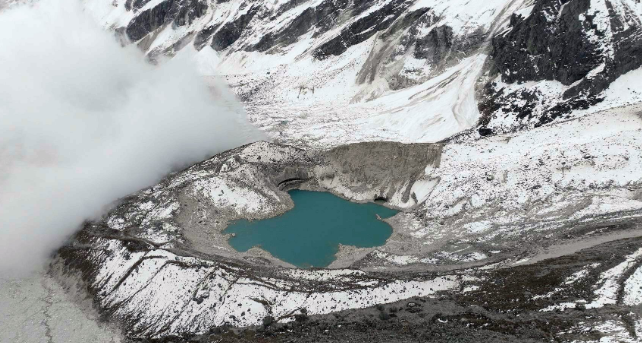
    Image :Drone image captured on 17 October 2024 shows Rhindi Cho, with an ice cliff indicating that the lake was formed on the glacier surface, and an erosional scar on the end moraine caused by the flood impact. ( Photo : Footage from SPCC )

    • Connecting you with the world of travel and tourism

      Media Partners

      Asia Amusement & Attractions Expo 2026

      Theme Park Expo Vietnam 2025

      Asia Pool & Spa Expo , May 10 – 12, 2025 , Guangzhou , China

      KAZAKHSTAN International Exhibition “Tourism & Travel” Almaty, Kazakhstan

      Nihao China- Beyond your imagination

      China extends visa-free

      policy to UK, Canada

      China has decided to extend its visa waiver policy to ordinary passport holders from Canada and the United Kingdom starting Tuesday, when the Chinese New Year begins, a Foreign Ministry spokesperson announced on , saying the move aims to further facilitate cross-border travel.

      According to the spokesperson, ordinary passport holders from the two countries can enter China without visa and stay for up to 30 days for business, tourism, family/friends visit, exchange and transit purposes.The policy will be effective until Dec 31.

      Air India Orders 30

      Boeing 737 MAX Jets

      Air India  has ordered 30 more fuel-efficient 737 MAX jets, expanding its Boeing order book to nearly 200 airplanes across the company’s single-aisle and widebody airplane families. Boeing and Air India  announced an order for 30 fuel-efficient 737 MAX jets at the annual Wings Airshow in Hyderabad.

      The airline finalized an incremental purchase of 20 737-8 jets this month and an order for 10 737-10 airplanes was previously unidentified on Boeing’s Orders & Deliveries website. Both purchases exercised existing options as Air India expands its route network to meet rising travel demand.

      Air India will operate the new 737-8s, leveraging their dispatch reliability, fuel efficiency and range flexibility on high-frequency, domestic and short-haul regional routes. The airline also plans to deploy the larger 737-10 to maintain operational commonality and carry more passengers at the lowest cost per seat among single-aisle aircraft.

      As Air India expands its fleet and network, Boeing’s Commercial Market Outlook forecasts the Indian and South Asian region will need nearly 3,300 new airplanes over the next two decades with 90% of those single-aisle jets like the 737 MAX. ( February 2 , 2026 )

      WTTC chooses  Madrid

      for new Global Office

      London, UK: The World Travel & Tourism Council (WTTC) announced that its Operating Committee has unanimously approved Madrid in Spain as the location for the organisation’s new Global Office.

      Five destinations expressed interest in hosting the Global Office – Dubai (UAE), France, Italy, Spain and Switzerland – with the evaluation criteria based on six areas: office rental and operating costs; the tax, incentives and competitive environment; fast-track visas and work permit frameworks in the destination; government support; cost of living to attract and retain talent; and proximity to international organisations.

      The decision to choose Madrid was endorsed by all 17 members of WTTC’s Operating Committee, following a comprehensive assessment of WTTC’s long-term strategic and operational needs. Members agreed that Madrid offered the most attractive option due to the city’s competitiveness, a more favourable tax environment, government support, easier visa processing for employees and overall lower operating costs. Challenges linked to Brexit, such as constraints on talent mobility, made the UK less attractive as WTTC wishes to further build its leadership position and become even more agile in the sector.

      Madrid was also selected for its strong international connectivity via Madrid-Barajas Airport, competitive business environment, incentives from government, synergies with international organisations in the sector such as UN Tourism and alignment with WTTC’s global mission. The new office will form a central part of WTTC’s worldwide network, supporting its highly-respected advocacy, research and member engagement activities across the globe.

      Bangkok named Asia’s best

      holiday destination for 2025

      Bangkok has been ranked as the best city to visit in Asia for 2025 by Smart Travel Asia, a leading digital travel magazine, based on the opinions of hundreds of thousands of travellers and readers worldwide.

      The city received the highest votes in the “Best Holiday Destination in Asia” category, retaining its top position for the second consecutive year.

      Smart Travel Asia highlighted Bangkok’s strengths as its 24-hour vibrancy and diverse experiences, including food, culture, shopping, and the friendliness of its people, describing it as a “city full of energy and colour, day and night.”

      The city’s dominance stems from several compelling factors. Bangkok has emerged as a paradise for food enthusiasts, offering everything from legendary street food stalls to Michelin-starred restaurants and panoramic 360-degree rooftop bars. Its cultural and heritage sites, including the iconic Wat Phra Kaew, Wat Arun, and Wat Pho temples, remain major attractions to international tourists.

      Additionally, from luxury malls in the city centre to the Chatuchak weekend market, Bangkok caters to every type of shopper. Affordability and friendliness also play a key role, as Bangkok remains an accessible living cost destination where welcoming smiles continue to charm travellers.

      In the Smart Travel Asia 2025 rankings, Bali (Indonesia) and Tokyo (Japan) shared second place behind Bangkok, while Seoul (the Republic of Korea) and Luang Prabang (Laos) tied for fourth. Thailand further strengthened its tourism appeal with Chiang Mai placing third and Phuket sharing fifth place with Hong Kong (China).

      Having the three cities, Bangkok, Chiang Mai, and Phuket, in the top 10 highlights the diversity and appeal of Thailand’s tourism offerings for travellers worldwide. — VNA/VNS ( Oct.12, 2025)

      Gulf Cooperation Council Tourism 

      Dubai – As tourism destinations in the Gulf Cooperation Council (GCC) continue to grow, involving local communities in destination development has become increasingly vital for long-term success.

      Abu Dhabi’s Tourism Strategy 2030 aims for 39.3 million visitors per year, while Saudi Arabia’s Vision 2030 targets 150 million domestic and international visits, emphasising how tourism is being established as a key element of economic diversification throughout the region.

      At Arabian Travel Market (ATM) 2025, industry leaders emphasised that sustainable revitalisation of destinations must align tourism investments with community partnerships, cultural authenticity, and immersive guest experiences to provide lasting value for both residents and visitors.

      During the session on “Considerations and Implications of Involving Communities in Destination Revitalisation” on the ATM 2025 Global Stage, experts shared insights into building resilience, enhancing local prosperity, and ensuring tourism growth is both inclusive and enduring.

      Arabian Travel Market 2025, held under the theme “Global Travel: Developing Tomorrow’s Tourism Through Enhanced Connectivity”,  featured more than 200 speakers across three content stages and welcomes over 55,000 travel professionals from 166 countries.

      Messe Berlin India launched 

      to drive growth of ITB India 

      Messe Berlin announces the official launch of Messe Berlin India, a newly incorporated subsidiary that underscores the company’s long-term commitment to one of Asia’s fastest-growing markets. Headquartered in Delhi , the new entity will serve as a strategic base for expanding ITB India and launching future projects tailored to the Indian market. With this establishment, Messe Berlin is reinforcing its vision of India as a regional hub for innovation, collaboration, and sustainable business growth within the exhibition and events industry.

      “Messe Berlin’s presence in India reflects our strategic intent to strengthen our international reach by being where the growth is. India is a key market for us — vibrant, diverse, and full of opportunities. With Messe Berlin India, we are laying down long-term foundations to build strong partnerships, support local industries, and elevate our global platforms,” said Dr. Mario Tobias, CEO, Messe Berlin.

      ITB India, inaugurated in 2023, continues as the flagship event under the new subsidiary. Held annually, ITB India is a three-day B2B travel trade show and convention that connects the global travel and tourism industry with the Indian market. Alongside MICE Show India, Travel Tech India, and the ITB India Conference, ITB India serves as a unique platform to forge new partnerships, strengthen existing ties, and capitalize on the fast-growing potential of the Indian and South Asian travel economies. The show hosts key players from the MICE, Leisure, Corporate Travel, and Travel Technology sectors. The upcoming edition, ITB India 2025, will take place from 2 – 4 September 2025  in Mumbai.

      FACTS —

      Tourism helps in:

      👉Reducing poverty

      👉Reducing Inequalities

      👉Promoting gender equality

      👉Fostering decent work and economic growth

      World Tourism Day 2021: ‘Tourism for Inclusive Growth’

      In 2019, Travel & Tourism’s direct, indirect and induced impact accounted for:
      -US$8.9 trillion contribution to the world’s GDP
      -10.3% of global GDP
      -330 million jobs, 1 in 10 jobs around the world
      -US$1.7 trillion visitor exports (6.8% of total exports,
      28.3% of global services exports)
      -US$948 billion capital investment (4.3% of total
      investment)

      Tibet Travel : Daily Life of Living under Mount Everest