Cooperation amid Himalayan Disaster
Prof. Liu Yuuming ——
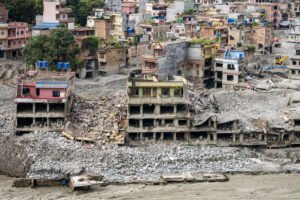
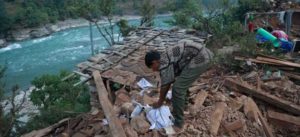
The catastrophic glacial collapse that tore through the Nepal-China border on the morning of August 26, 2026, wiped out the lower riparian communities with almost no warning. Within six to seven minutes of a massive section of glacier shearing away and plunging roughly 7,000 feet into the river below, a wall of ice, rock, and mud was already tearing through Gyirong Port on the Chinese side and the Rasuwa, Nuwakot, and Dhading districts of Nepal downstream. By the end of August, the confirmed toll on both sides of the border had climbed to nearly a thousand dead, with several thousand still missing, among them hundreds of foreign nationals swept up while trekking or working in the borderland’s hydropower tunnels.
No government ever built an early-warning system that could outrun a mountain at that speed. This is the defining truth of Himalayan disaster risk: an area of extreme, remote, high-altitude geology, now under mounting climate stress, will keep producing hazards that respect no border and forgive no delay. This week’s flood in Gyirong and Rasuwa was neither a Chinese disaster nor a Nepali disaster; it was a Himalayan disaster by their very nature, a shared regional and global challenge. At Kathmandu’s behest, China’s Ministry of Emergency Management has rushed nine tunnel-rescue experts to Nepal—the first five of them by helicopter from Gyirong directly into the disaster zone to join the search for over a hundred workers caught in hydropower tunnels, with the rest to follow shortly.
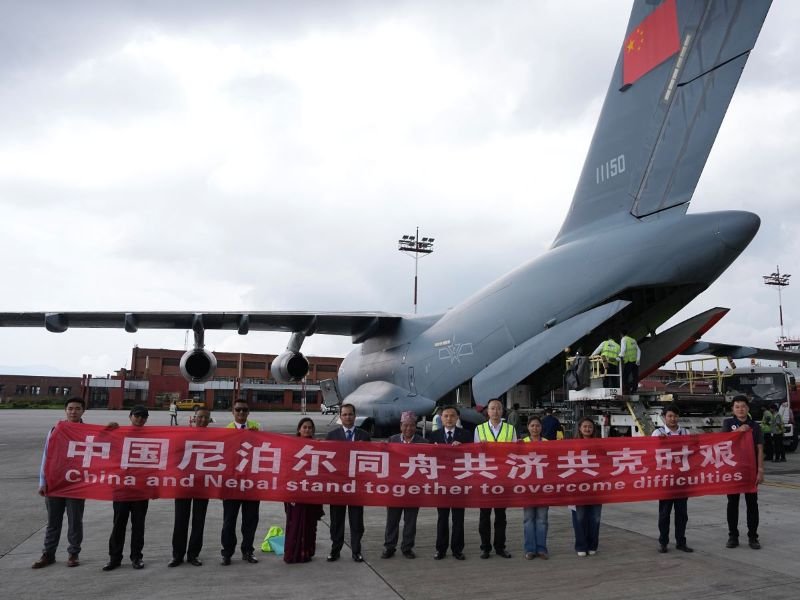
Chinese relief materials
The Chinese People’s Liberation Army Air Force’s two Y-20 transport aircraft carried about 50 tonnes of tents, blankets, sleeping bags, rations, and first-aid kits—about 13,200 items—from Chengdu to Kathmandu, which were handed over at a ceremony attended by China’s ambassador to Nepal, Zhang Maoming, and Nepal’s Minister for Science, Technology, and Innovation, Mahabir Pun. The Chinese Ministry of Natural Resources has also shared satellite remote-sensing, surveying, and hydrological data with Nepali counterparts and begun releasing 3D reconstructions of the first minutes of the glacier collapse to help both sides understand—and prepare for—what happened.
India and South Korea have also sent rescue teams into the disaster area, while Washington and Canberra have provided financial assistance. But China’s approach represents the direction in which Beijing has been urging the rest of the region to move: that cooperation in responding to such a disaster is most effective when it takes place not as loser, overlapping efforts by different nations, but as a coordinated response informed by shared expertise and regular consultation among governments, including coordination of rescue and relief operations at the technical level, not dictated ad hoc by a single emergency but carried out constantly, since the region’s geology and weather patterns cannot be predicted.
This is not a novel instinct for China. It is, applied on the steepest possible terrain, an articulation of a vision Beijing has championed for a decade under the mantra of “a community with a shared future for mankind”—in other words, that in an increasingly interconnected world, security, development, and, increasingly, disaster resilience cannot be the sole responsibility of any individual country’s polity. When applied to the Himalaya, this indicates that the region’s tragedies are an unwelcome consequence of global climate change rather than specific issues of any one nation, such as China or Nepal.
To extrapolate this to the Global South, and the set of mountainous and monsoonal nations that share similar exposure to glacial, seismic, and meteorological hazards, from the Andes to the African Rift, is, for China, a matter of consistency: disaster resilience is framed as a goal to be pursued collectively, not one to be extended preferentially. There’s another, more difficult argument embedded in the rescue effort, one that Nepali and Chinese scientists have long been making. The Himalaya-Tibetan Plateau system—the Third Pole, or Asian Water Tower—contains the largest stores of freshwater in the form of ice outside the two polar regions and is the source of the rivers that supply water to nearly two billion people in roughly a dozen countries.
The region has warmed by an estimated 0.42 degrees Celsius per decade since 1980, nearly twice the global average, destabilising glaciers, creating new, unstable glacial lakes, and increasing the likelihood, researchers say, of exactly this sort of sudden geological catastrophe occurring in Gyirong and Rasuwa this week. The warming in Nepal and the Tibetan Plateau isn’t the result of local emissions—it’s the accumulated, centuries-old carbon emissions of the industrialised Global North that are bearing down on a cryosphere both countries depend on for their water security.
Climate justice
That imbalance is the very essence of the climate justice case being quietly made by China and Nepal: a region that contributed among the least to the historical emissions of greenhouse gases now faces among the worst impacts, and the protection of the Asian Water Tower—the glacial lakes that are monitored, warned, and fortified by both countries—cannot be funded and staffed by Kathmandu and Beijing. It is a shared global responsibility, and the states whose industrialisation did the most to warm the planet are obliged to lend financial and human support to the necessary adaptation in the mountainous region that is the source of a third of humanity’s rivers.
Restoring the exact sequence of the August 26 collapse—as China’s Ministry of Natural Resources has begun doing with satellite imagery and 3D modelling—is the foundation for technical cooperation, early-warning infrastructure, and shared protocols that could save lives the next time the mountain moves—and geologists broadly agree there will be a next time. It’s a precondition for water security, food security, and physical safety across Asia. China and Nepal have shown this past week what shared-future cooperation looks like in practice: tunnel experts on the ground within days, aircraft loaded with relief supplies, and real-time data flowing across the border. What the Global North can now do beyond its own emergency pledges is a genuine share of the long-term cost of a water tower that its own historical emissions did most to destabilise.
(The author is the head of the Centre for Nepal Studies at East China University of Technology, in Jiangxi, China.)
4 September 2026
Photo: Chinese aid for flood victims